


Utah is one of the most homeschool-friendly states in the country. The legal requirements are minimal, the process is straightforward, and state funding programs can make it even more accessible. Whether you are considering pulling your student out of public school or starting fresh with home education, this guide covers everything you need to know about Utah homeschool laws in 2026.
Ready to start homeschooling in Utah? Explore Ideal School’s accredited online programs that qualify for Utah Fits All Scholarship funding. Call 1-888-390-7044 or contact us to learn more.
Key Takeaways:
- Utah requires only a one-time notification to your local school district to begin homeschooling.
- There are no curriculum requirements, standardized testing mandates, or attendance records needed.
- Parents do not need teaching credentials or a college degree.
- The Utah Fits All Scholarship provides up to $8,000 per student for educational expenses.
- Recent changes under HB 209 (effective May 2025) simplified the process by replacing the old affidavit system.
Is Homeschooling Legal in Utah?
Yes. Homeschooling is fully legal in Utah under Utah Code Ann. § 53G-6-204. The state recognizes that parents have the right to educate their school-age children at home instead of enrolling them in a public or private school.
Once a family properly notifies their local school district, the student is legally excused from compulsory school attendance. Utah is widely regarded as one of the least regulated states for homeschooling, giving families significant freedom over curriculum, scheduling, and teaching methods.
Compulsory School Age
Utah requires all children between the ages of 6 and 18 to receive an education. This applies to students in both traditional schools and homeschool programs. When a family files a homeschool notification, the student is legally excused from public school attendance for those years.
How to Start Homeschooling in Utah: Step-by-Step
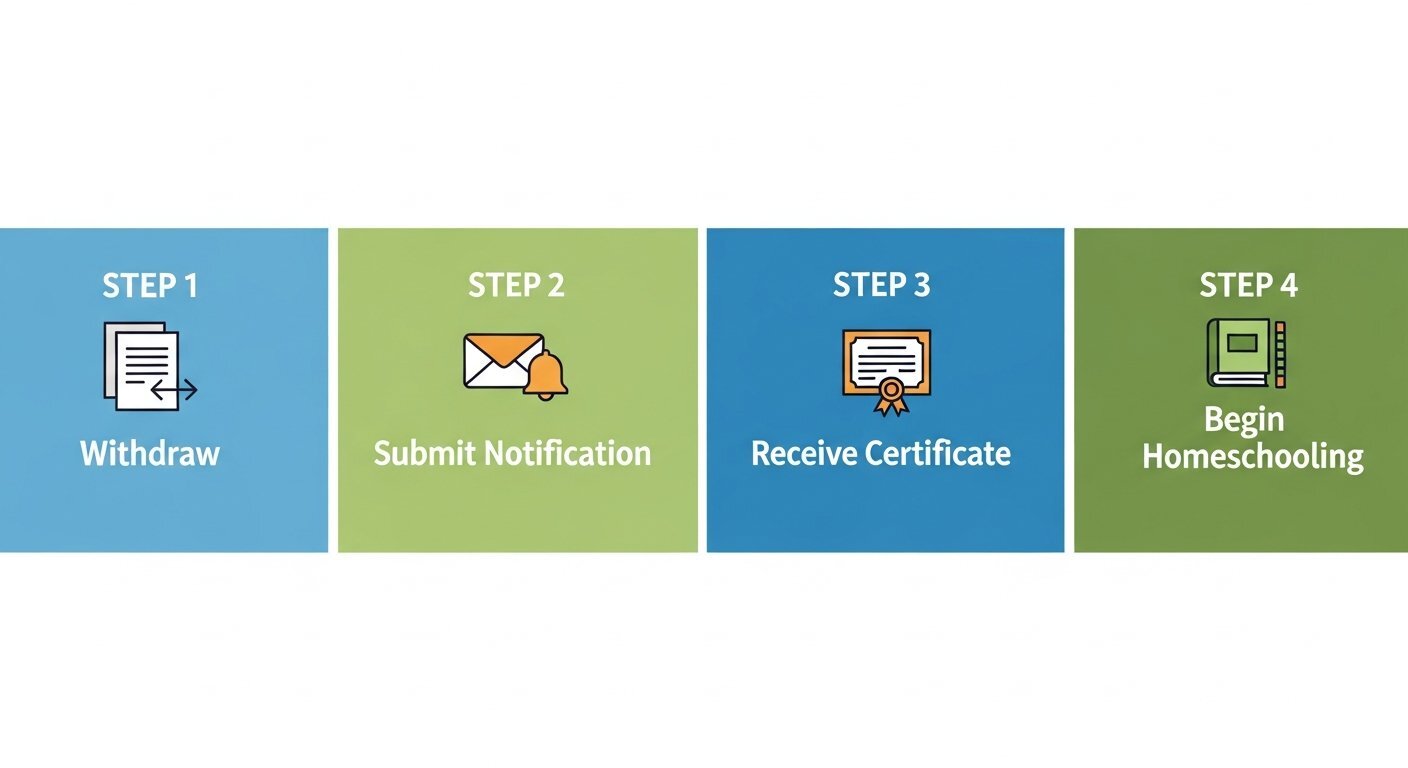
Starting a homeschool program in Utah involves just a few simple steps. Here is the process from start to finish.
Step 1: Withdraw Your Student (If Currently Enrolled)
If your student is currently attending a public or private school, notify the school that you plan to homeschool. Request a formal withdrawal to prevent any confusion about attendance records or truancy concerns.
Step 2: Submit a One-Time Notification
Utah law requires parents to provide a one-time initial notification to the local school board of the school-age student’s district of residence. This notification informs the district that you intend to educate your student at home.
Key details about the notification:
- It only needs to be submitted once, not every year.
- You can write your own notification letter or use a form provided by your district.
- The notification should state that your student will attend a home school and that you assume sole responsibility for their education.
- As of May 2025, under HB 209, parents are no longer required to attest to criminal background history in the notification.
Step 3: Receive Your Excuse Certificate
Within 30 days of receiving your notification, the school district will issue an excuse certificate acknowledging your homeschool program. This certificate confirms that your student is legally excused from public school attendance.
Some districts issue a certificate that remains valid for the duration of your notification. Others issue new certificates annually by August 1st. Either way, you do not need to refile your notification as long as you continue to homeschool in the same district.
Step 4: Begin Homeschooling
Once you have your excuse certificate, you are free to start educating your student at home. Utah gives parents complete control over curriculum, materials, schedule, and teaching methods.
Utah Homeschool Requirements at a Glance
| Requirement | Utah Law |
|---|---|
| Initial Notification | Required once per student |
| Parent Qualifications | None required |
| Curriculum Approval | Not required |
| Standardized Testing | Not required |
| Attendance Records | Not required |
| Teacher Certification | Not required |
| Days/Hours of Instruction | Not mandated |
Utah does not impose curriculum standards, testing requirements, or attendance tracking on homeschool families. The parent is solely responsible for:
- The selection of instructional materials and textbooks
- The time, place, and method of instruction
- The evaluation of home school instruction
The school district has no authority or responsibility over any of these areas for homeschooled students.
Recent Changes: HB 209 Homeschool Amendments
Utah’s homeschool laws were updated through House Bill 209, which took effect on May 7, 2025. This legislation simplified the homeschool process in several important ways:
- Replaced the affidavit with a notice of intent: Families no longer need to submit a notarized affidavit. A simple one-time notification is now sufficient.
- Removed criminal background attestation: Parents are no longer required to disclose criminal background history when notifying the district.
- Clarified notification timing: The bill clarifies when notification is required, particularly for students who begin homeschooling at the start of an academic year.
- Reduced school board liability: Local school boards are no longer liable for the education of a student after unenrollment.
Important: If you previously filed an affidavit under the old system, you are not required to submit a new notice of intent for that student. Your existing affidavit remains valid.
Curriculum and Testing in Utah
One of the biggest advantages of homeschooling in Utah is the freedom you have over what and how your student learns. The state does not require:
- A specific curriculum or textbooks
- Standardized testing at any grade level
- Portfolio reviews or progress reports
- Submission of lesson plans or educational goals
This means you can choose a curriculum that fits your student’s learning style, interests, and goals. Many families opt for accredited online programs, co-op classes, traditional textbook curricula, or a combination of approaches.
Why Accreditation Matters
While Utah does not mandate any particular curriculum, choosing an accredited program ensures that your student’s coursework is recognized by colleges, universities, and other schools. Accreditation from a recognized body like Cognia confirms that the program meets high educational standards, which is particularly important if your student plans to pursue higher education or transfer credits.
Utah Fits All Scholarship: Funding for Homeschool Families
The Utah Fits All Scholarship is a state-funded program that provides financial support to homeschool and private school families. This scholarship can significantly reduce the cost of educating your student at home.
How It Works
- Eligible families can receive up to $8,000 per student per year.
- Funds are deposited into a scholarship account managed through the Odyssey platform.
- The money can be used for tuition, curriculum materials, textbooks, school supplies, tutoring, educational field trips, and even computer hardware (once every three years).
Eligibility Requirements
To qualify for the Utah Fits All Scholarship, families must meet these criteria:
- The student must be a Utah resident in grades K-12.
- The student must not be enrolled in or attending a public school.
- The student must not be receiving the Carson Smith Special Needs Scholarship or the Special Needs Opportunity Scholarship.
Application Timeline
Applications typically open in early spring. For the current cycle, key dates include:
- Applications Open: March 2025
- Applications Close: April 30, 2025
- Award Notification: No later than May 2025
- Funding Account Established: No later than August 2025
Applications are not first come, first served. A lottery system is used when applications exceed available funding.
Using the Scholarship with Ideal School
Ideal School is a qualified provider under the Utah Fits All Scholarship program. With tuition averaging between $5,000 and $6,000 per year, many families can cover the entire cost of their student’s education through the scholarship, meaning zero out-of-pocket tuition.
Dual Enrollment for Homeschoolers
Under Utah Code 53G-6-702, homeschooled students have the right to dual enrollment in their local public school. This means your student can:
- Take individual classes at the local public school
- Participate in extracurricular activities, including sports
- Access school resources and facilities
If your student is using Utah Fits All funding, they will need to identify themselves as a UFA student to the school or district, as enrollment tracking works differently for scholarship recipients.
Special Education for Homeschooled Students
If your student has a disability, it is important to understand how special education services work in a homeschool setting:
- The local school district is still responsible for identifying and evaluating homeschooled students who may have disabilities.
- However, if you choose to homeschool, you may be waiving your right to some or all special education services (IEP, 504 plans, and other related services) unless you arrange for dual enrollment.
- It is recommended that you meet with the IEP or 504 team at your boundary school before submitting your homeschool notification to understand what services your student would retain.
Home schools do not meet the legal definition of private schools under Utah Board Rules R277-438, so the service frameworks differ.

How Ideal School Works with Utah Homeschool Families
For families who want the structure of a full academic program combined with the flexibility of homeschooling, Ideal School’s Full Day Program offers an accredited, bilingual online education for students in grades K-12.
Here is what sets Ideal School apart for Utah families:
- Internationally accredited by Cognia, so credits and diplomas are recognized worldwide.
- Live, interactive classes with professional bilingual teachers in real-time. Students are not watching pre-recorded videos; they are participating in a real classroom.
- Dual language immersion in English and Spanish, connecting students from 20+ countries in a global learning environment.
- Flexible program options including Full Day, Asynchronous, Mixed, and Supplemental Homeschool Classes.
- Qualified Utah Fits All provider, so families can use their scholarship to cover tuition with no out-of-pocket cost.
Book a free live demo class to see how Ideal School works for your family.
Frequently Asked Questions
Do I need a teaching degree to homeschool in Utah?
No. Utah does not require parents to have any teaching credentials, certifications, or college degrees to homeschool their students. You are solely responsible for directing your student’s education, but no formal qualifications are needed.
Do I need to file paperwork every year?
No. Utah only requires a one-time notification to your local school district. You do not need to refile annually. Your notification remains valid as long as you continue to homeschool in the same district. If you move to a new district, you will need to file a new notification with the new district.
Does Utah require standardized testing for homeschoolers?
No. Utah does not require homeschooled students to take any standardized tests. However, if you want your student to participate in state testing, you can arrange this through your local school district.
Can my homeschooled student play sports at the local public school?
Yes. Under Utah’s dual enrollment law (53G-6-702), homeschooled students can participate in extracurricular activities, including sports, at their local public school. Contact your district to learn about specific requirements and registration deadlines.
How do I get the Utah Fits All Scholarship?
Apply through the Utah Fits All Scholarship program during the annual application window (typically March through April). Applications are selected through a lottery process. Visit the Utah Fits All Scholarship page for current application dates and eligibility details.
Can I homeschool a student with special needs in Utah?
Yes, but be aware that homeschooling may affect your access to certain special education services. Your local school district is still required to identify and evaluate students with disabilities, but IEP and 504 services may be limited unless you arrange for dual enrollment. Speak with your boundary school’s special education team before making the transition.

Written by
Eric C. Franzen
Eric C. Franzen is co-founder and owner of Ideal School, with 20+ years of experience as an educational leader and entrepreneur. He holds a BA in Education from the University of Washington and an MA in Educational Administration from Seattle Pacific University.
View LinkedIn Profile →