



The right online school for expat families is a full K-12 school, not simply a tutoring service, language class, or collection of supplemental courses. Look for a clearly defined grade-level program, live teacher instruction, reliable academic records, transparent recognition policies, and communication that works for a globally mobile family. Ideal School is a Cognia-accredited virtual private K-12 school with live instruction and a full-day program, while families should still confirm how any school fits their destination country’s requirements.
Choosing well means comparing the school’s actual structure with your student’s needs today and the possibility of another move tomorrow. Start by separating a complete school experience from supplemental offerings, then examine continuity, language support, class schedules, records, and parent-school communication. Those details reveal whether an online program can provide a practical, stable path for your family.
What Should Expat Families Look For in a K-12 Online School?
Start by matching the program to the student’s actual school-day needs, not just the fact that classes happen online. Families comparing an online school for expat families should confirm the grade level, subjects, teaching model, and level of support before considering convenience or location. Continuity, recognized schooling, English instruction, bilingual development, and the ability to adapt after a move are all relevant parts of that decision.
Confirm that the program covers the full school day
A full-day K-12 school should provide a coherent sequence across grade levels and core subjects. At Ideal School, the full-day program includes live instruction in English Language Arts, Spanish Language Arts, mathematics, science, and social studies. Review the full-day K-12 program to see whether its subjects and scheduled live classes align with the student’s current grade and your family’s expectations.
Do not assume that every online offering is a replacement for school. Supplemental classes, tutoring, and language programs can be useful additions, but they may not provide the complete curriculum, records, daily structure, or school community a student needs. Ask directly whether you are evaluating a full-day enrollment option or a subject-specific service, and what is included in each.
Look for continuity and practical support
Families who relocate need more than a list of subjects. Ask how the school maintains curriculum continuity when a student changes location, how progress is communicated, and who helps the family understand policies or next steps. A school serving an international community may also offer a useful multicultural setting. Ideal School reports serving students in more than 20 countries, while its dual-language classrooms bring English- and Spanish-speaking students together.
Finally, review the transfer process before a move is urgent. The transfer to online school guide can help you organize questions about records, timing, and readiness. Treat any school as a potential fit only after confirming its policies for your student’s grade, schedule, language needs, and family circumstances.
How Should Families Check Accreditation and Local Recognition?
Accreditation is an important starting point, but it is not the same as automatic recognition everywhere. When comparing an online school for expat families, ask which organization accredits the school, what records it provides, and which authority will decide whether those records meet local requirements. Ideal School identifies itself as a Cognia-accredited virtual private K-12 school. You can review its Cognia accreditation information, then confirm how the destination country or a future receiving school handles enrollment and academic records.
Questions to ask when checking school recognition
| Area to verify | What to ask the school or local authority | Why it matters |
|---|---|---|
| Accreditation | Is the school currently Cognia-accredited, and can it provide official documentation? | It identifies the school’s external quality status without claiming universal equivalence. |
| Transcripts and records | Which transcripts, progress reports, recommendations, and completion records are issued, and how can they be sent? | Complete records make a move or later school review easier to evaluate. |
| Local requirements | What compulsory-education, registration, language, or document rules apply at the family’s destination? | Requirements vary by school district and jurisdiction, so families must confirm them locally. |
| Future transfer | Will the receiving school or relevant authority review these records before enrollment? | Accreditation does not guarantee transfer-credit acceptance or equivalency in every country. |
The U.S. Department of State recommends checking school documents and entrance requirements when transitioning to an overseas school. Its transition guidance also advises families to hand-carry transcripts and other important education and identity records. Use that same State Department transition page as a practical reminder to verify current requirements, rather than relying on a general description of a school.
For a second perspective on evaluating records and school legitimacy, read this guide to online diploma legitimacy. Before enrolling, contact the destination’s education authority and any likely receiving school. Ask them to review the exact school, grade level, transcript format, and planned transition. That conversation is more reliable than assuming recognition from accreditation alone.
How an Online School for Expat Families Supports Continuity
For a family that may move before the school year ends, continuity means more than keeping a familiar subject sequence. It means giving a student a dependable academic setting, known routines, and relationships that can continue while home, language, and community change. Ideal School is a Cognia-accredited virtual private K-12 school founded in Seattle in 2018, and it reports serving students in more than 20 countries. That international community can give students a shared point of connection wherever the next move takes the family.

What can remain stable during a relocation?
A full-day K-12 school model can provide a clearer throughline than assembling separate tutoring, language, or supplemental classes after every move. Students may continue learning with scheduled live instruction, familiar expectations, and teachers who understand the school community. That stability can be especially useful when a relocation brings a new local calendar, a different language environment, or a temporary housing arrangement.
Records are another part of continuity. Keep copies of transcripts, evaluations, recommendations, health documents, and other school records with the family rather than assuming that every institution will transfer information automatically. The U.S. Department of State advises families changing schools overseas to hand-carry important educational and identity records, including transcripts and immunization records. You can review its school-transition guidance as part of your planning.
What continuity does not guarantee
Continuity does not guarantee that a receiving school, local authority, or future country will accept every credit, record, or course as equivalent. Requirements vary, so families should confirm local compulsory-education rules and recognition questions before relocating. An online school for expat families can reduce disruption, but it cannot replace destination-specific checks. Ask what records will be provided, how progress is documented, and which decisions remain with the receiving school or local authority.
How Do Live Online Classes Work Across Time Zones?
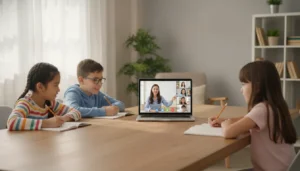
Online learning is not automatically asynchronous. Ideal School’s full-day program uses scheduled, live classes, which means families should understand when students are expected to be present before they enroll. Live teacher-led instruction can create consistency across borders, but a schedule described as flexible still needs to work in the student’s actual location and daily routine.
Start by requesting the class timetable in the time zone where your family lives. Then convert each class to local time and note the earliest start, latest finish, breaks, and any recurring commitments. A schedule that looks reasonable in the school’s published time zone may place a core class before the student’s practical morning begins or late in the evening. Families considering the model can also review these live online school benefits alongside the attendance expectations.
Questions to test before choosing a schedule
- What are the required live class hours for this grade and program?
- Which subjects meet at the least convenient times for our location?
- How would the schedule fit with meals, sleep, work commitments, and local activities?
- What attendance process applies when a student cannot attend a scheduled class?
Do not assume that every class can be moved, watched later, or attended from any time zone. Ask the school to explain the actual schedule and attendance policy for the student’s grade. Comparing those details with a typical weekday gives families a more reliable answer than the phrase “flexible online school.”
What Should Bilingual Families Evaluate?
A bilingual option should be evaluated as an academic model, not only as an opportunity to hear two languages. Ask how English and Spanish are used across the school day, which subjects are taught in each language, and how the model supports students as academic vocabulary becomes more demanding. Ideal School describes its approach as a two-way dual-language model that brings English- and Spanish-speaking students together, with instruction allocated across both languages.
Look beyond conversational fluency
Clarify whether language allocation is consistent by subject, grade, or instructional unit. A strong fit should account for reading, writing, mathematics, science, and social studies, rather than treating Spanish as an isolated enrichment period. Ideal School’s full-day program includes live English Language Arts, Spanish Language Arts, mathematics, science, and social studies. Ask how teachers introduce technical terms, assess understanding, and support a student who is stronger in one language than the other.
Grade-level fit matters as much as language balance. A student may speak Spanish at home but need support with formal academic Spanish. Another may understand classroom Spanish but need more time to produce written work. Before enrolling, ask what prior language experience is expected, how placement is determined, and how progress is communicated to families. The school’s stated methodology is active, engaging, reflective, and collaborative, so families can also ask how students participate and work with peers in both languages.
Confirm the service your family needs
Separate a full-day K-12 school from a supplemental language class, tutoring, or an after-school offering. Families seeking daily instruction across core subjects need to review the full-day schedule, curriculum, teacher interaction, and grade progression. Families who already have a primary school may need only targeted language support. These are different decisions with different expectations for records, attendance, and academic continuity.
For more detail on the instructional approach, read about bilingual online K-12 education. Families specifically comparing secondary options can also review this guide to a Spanish immersion high school.
How Can Parents Stay Connected to the School?
School communication should be easy to understand, consistent, and useful when your family is managing school from another location. Before choosing an online school for expat families, ask how parents will see updates, contact teachers, discuss progress, and receive help when a question involves language or local circumstances.
Check the communication channels
Look for a clear parent portal where families can find important information, along with direct teacher messaging for questions about assignments, participation, or day-to-day concerns. Ask how quickly teachers typically respond, which messages belong in the portal, and whether parents can contact the appropriate person when an issue involves more than one subject.
Conferences provide a more focused opportunity to discuss academic progress, learning habits, and next steps. Ask whether conferences are scheduled regularly, how families prepare for them, and whether another adult can join when parents are working across time zones. You can learn more about the school community and its Ideal School teachers before making a decision.
Ask for progress information you can use
Progress updates should help you understand more than a single score. Ask what evidence families receive, how often updates are shared, and how teachers explain areas that need attention. Also clarify how bilingual support works in parent communication and conferences. If your family uses both English and Spanish, ask which language options are available and whether interpretation or bilingual communication is part of the school’s regular process.
Finally, describe your family’s circumstances before enrollment. Explain your time zone, preferred communication language, any planned move, and the type of support your student may need. A direct conversation can reveal whether the school’s policies and communication routines fit your family better than a general promise of support.
What Should You Confirm Before Enrollment?
A short checklist can prevent surprises when your family is comparing an online school for expat families. Gather records first, then confirm the school model, schedule, technology, and local requirements directly with the school and relevant authorities.
- Collect documents and academic records. Prepare transcripts, birth certificates, identity records, individualized education program documents if applicable, standardized test results, immunization and health records, and teacher recommendations. The U.S. Department of State recommends hand-carrying key school and identity records when families change schools. Ask which documents need translation, certification, or secure digital copies.
- Verify local education rules. School and district requirements vary. Confirm the compulsory-education rules, registration obligations, and recognition process that apply in your destination. Accreditation does not guarantee transfer-credit acceptance or equivalency in every country, so ask the relevant local authority and any receiving school what they require.
- Confirm the program fits the student. Ask whether you are considering a full-day K-12 school program or a separate supplemental class, tutoring, or language offering. Review the grade-level curriculum, teacher interaction, student support, language allocation, and records policy. The State Department also advises families to ask about curriculum and special-needs instruction availability.
- Review the calendar and class times. Request the current schedule and compare every live class with your local time zone. Do not assume online delivery is asynchronous or fully self-paced. Ask how attendance, absences, holidays, and a move across time zones are handled. School calendars may use semesters, but confirm the specific dates and enrollment process with the school rather than relying on a general fact sheet.
- Test the technology and learning space. Confirm the required device, browser, internet connection, camera, microphone, software, and backup plan. Ask how technical issues are reported and how a student accesses missed work or teacher help. A brief trial can reveal whether the home setup supports focused live participation.
- Clarify parent communication. Ask how families receive progress updates, contact teachers, attend conferences, use the parent portal, and request bilingual support. Also confirm who answers questions during enrollment and how quickly families should expect a response.
- Write down the questions that remain. Ask about records, local compliance, curriculum, class times, student support, technology, attendance, and the transition process. The State Department notes that general school information should be followed by direct inquiries for current, specific details. Keep written answers with the student records.

Review enrollment information and use your questions to request the details that apply to your family and destination.
Frequently Asked Questions
Can students attend an online school while living abroad?
International attendance can be possible, but families should confirm enrollment eligibility, local education rules, and any documentation requirements for their destination. Ask whether the school serves students in your location and how it supports communication across borders. Ideal School reports serving students in more than 20 countries, but each family’s circumstances still need individual review.
Are online school qualifications recognized internationally?
Recognition is not automatic in every country. Review the school’s accreditation, transcript and diploma policies, then ask the relevant local authority or receiving school how those records will be evaluated. Ideal School advises families to independently confirm recognition, transfer-credit rules, and compulsory-education requirements before enrolling. See the school’s accreditation information for details to verify.
How do live online classes work across time zones?
Start by converting the proposed class schedule to your local time and checking whether it fits the student’s daily routine. Scheduled live classes are not automatically asynchronous or self-paced, so ask about attendance expectations, participation, and how schedule changes are handled. Ideal School specifically recommends that families check class times against their time zone.
Can a student transition to an online school during the school year?
A mid-year transition depends on the school’s placement process, available grade-level space, records, and the student’s academic circumstances. Ask which transcripts, reports, and identity documents are needed, and how prior coursework will be reviewed. The U.S. Department of State advises families changing schools overseas to check entrance requirements and hand-carry key educational records.
What technology and family setup support a good fit?
Ask for the school’s current device, internet, camera, software, and learning-space requirements before making a decision. Also consider who will help with daily routines, how parents receive progress updates, and whether the teaching language and schedule fit the household. A strong match depends on the full program, student support, and family circumstances, not technology alone.
Get started with a thoughtful enrollment review
Choosing an online school is a meaningful decision for an expat family. Reviewing the enrollment information can help you consider whether the K-12 program fits your location, schedule, language goals, and records needs before taking the next step.
Review Ideal School enrollment information

Written by
Eric C. Franzen
Eric C. Franzen is co-founder and owner of Ideal School, with 20+ years of experience as an educational leader and entrepreneur. He holds a BA in Education from the University of Washington and an MA in Educational Administration from Seattle Pacific University.
View LinkedIn Profile →