

Online School Community: What Families Should Look For
Last updated: September 23, 2026
A connected online school community does not happen just because students share a video call. Families can look for clear routines, engaged teachers, student-to-student interaction, and regular two-way communication that make learning feel shared rather than isolated. This guide turns those signs into practical questions parents can ask while considering a K-12 online school.
Explore enrollment at Ideal School
In a recent BoldJourney interview with Eric C. Franzen, the Ideal School co-founder reflects on lessons from his grandparents and volunteer service in Guatemala. He describes how both shaped his view that honest work is honorable, and that humility and helping others matter. Those are personal reflections, not a school quality rating. They do, however, invite a useful family question: how can a school’s stated values become visible in everyday learning?
What does a strong online school community look like?
A strong online school community is a learning environment where students, teachers, and families have meaningful ways to participate, communicate, and support shared academic goals. Look for more than a platform or a friendly welcome: the school should explain how live classes, feedback, family communication, and student connection work in practice. These observable routines give families a more useful basis for evaluation than a broad promise of community.
For an online K-12 school, community has to be built with intention. Students may not pass one another in a hallway, but they can still learn together through live instruction, class discussion, group work, and school activities. Teachers help set the tone when they invite questions, recognize contributions, and make participation feel safe and purposeful.
Families can begin by checking the school’s public explanation of the student experience. Does it show how students interact with teachers and peers? Does it explain how caregivers can ask questions or understand progress? Clear answers help a family picture the actual learning environment, not just the technology used to deliver it.
How can families evaluate connection in a virtual classroom?
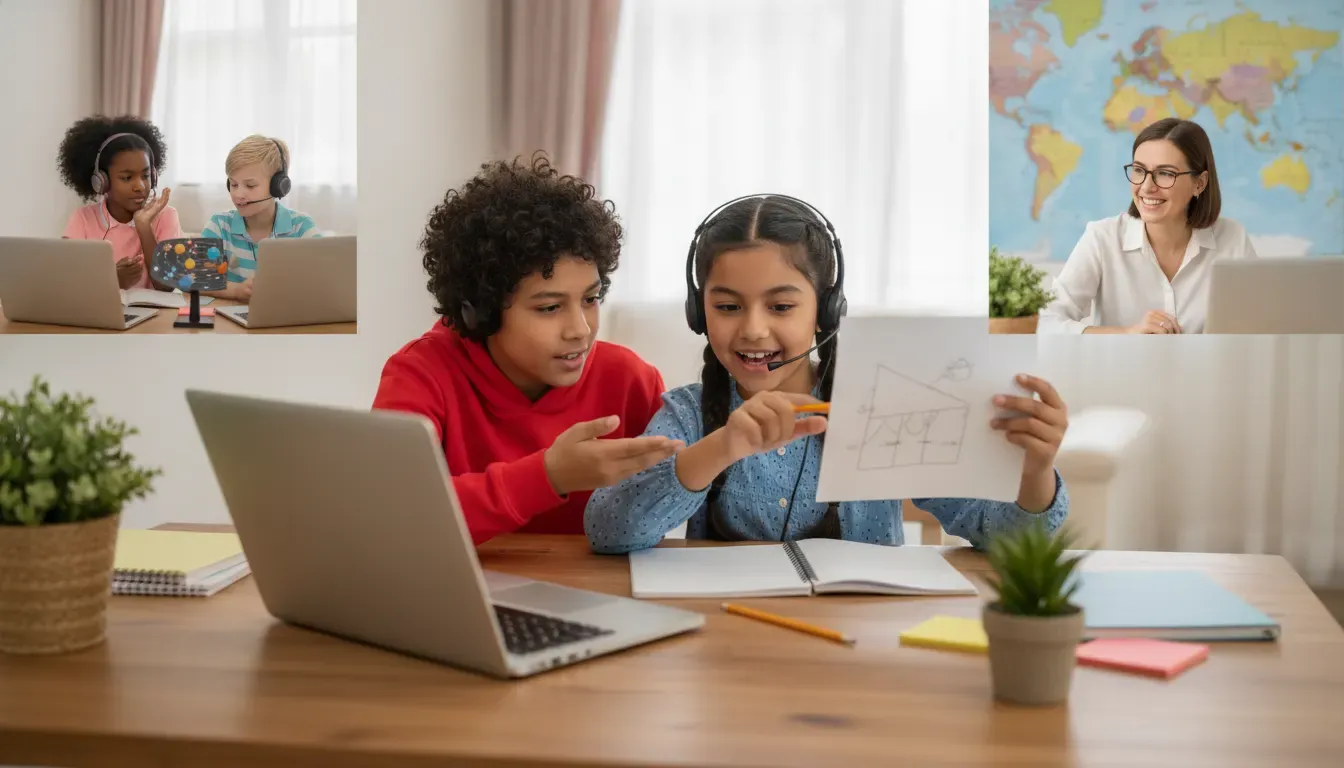
Families can evaluate virtual classroom connection by looking for consistent, live opportunities for students to participate with teachers and peers. A school should be able to describe how lessons encourage discussion, how teachers notice when students need help, and what students do together beyond listening to a presentation. The goal is not constant activity, but a purposeful setting where each student can contribute and receive attention.
Use these questions when reviewing a school’s class model:
- Are classes live, recorded, or a mix, and what does a typical week look like?
- How do teachers invite questions and check that students understand?
- Do students have structured chances to speak, collaborate, or share work?
- How can a family contact the teacher when a concern comes up?
- What academic or social support can students access outside class?
- Can the school show examples of projects or student participation?
Specific answers matter more than polished claims. A family should be able to understand the rhythm of a school day, the teacher’s role, and the way students connect. If the school offers a class demonstration, that can help parents observe how interaction works before making a decision.
Ideal School describes its model as live, interactive K-12 instruction in English and Spanish. Its Full Day Program outlines daily live classes across core subjects, and the class demo page gives families a way to see the classroom experience. These details help explain the structure; each family should still consider whether the model fits its student’s learning goals and schedule.
Which routines help an online school feel connected?
Connected online schools rely on repeatable routines that help students know when to participate, how to ask for support, and how learning continues between classes. Routines can include regular teacher communication, predictable class expectations, collaborative projects, and school activities that bring students together. Families can ask how these practices work across grade levels instead of assuming that an online platform creates connection on its own.
Some routines focus on learning. Teachers may make time for questions, give timely feedback, and invite students to explain their thinking. Other routines keep families informed, such as parent-teacher conferences, school updates, or a message center. The strongest systems make expectations clear while leaving room for a student to ask for help in a way that feels comfortable.
Research and practitioner perspectives also point to intentional design. An Edutopia article on building community in an online school describes strategies such as shared expectations, interactive activities, and feedback culture. The Institute of Education Sciences overview of family engagement in distance learning emphasizes two-way communication and meaningful partnerships between schools, families, and communities. These sources offer broader ideas, not proof that every school applies them.

Why does family communication matter in an online school?
Family communication matters because caregivers need clear ways to understand learning, share observations, and ask questions. Two-way communication is more useful than occasional announcements: families should know whom to contact, when to expect updates, and how teachers respond to concerns. Those details can show whether a school treats families as partners in a student’s education.
The Institute of Education Sciences describes family engagement as an ongoing process built on two-way communication and meaningful goals for students. In practice, parents can look for accessible contact routes, understandable updates, and regular chances to discuss progress. They can also ask how the school welcomes different family perspectives and what happens when a student needs additional support.
Ideal School’s public About page describes family involvement, communication practices, and its Community Advisory Committee. Families can review those details alongside the school’s programs and ask follow-up questions through the appropriate school channels. The point is to evaluate what is described and confirmed, not to assume every family will need the same kind of communication.
How do shared values become part of a school’s daily experience?
Shared values become meaningful when people can recognize them in ordinary interactions. A school that values respect, curiosity, or responsibility should be able to show how those ideas shape classroom expectations, feedback, family communication, and student participation. Families can ask for examples of how teachers help students practice these values, rather than relying only on mission statements.
The BoldJourney profile connects Franzen’s personal perspective to examples from his family history and volunteer experience. His account of learning humility and respect for honest work is a founder’s reflection; it should not be confused with an independent evaluation of school outcomes. For families, its most practical connection is a prompt to look for consistency between a school’s stated principles and the learning experience it describes.
A helpful conversation might include questions such as: How do teachers encourage students to listen to one another? How does the school respond when a student is struggling to participate? How can parents share feedback? What does the school do to make the classroom welcoming to students with different experiences? Thoughtful answers can reveal how a community approaches care and shared responsibility.
What should families compare before choosing an online school?
Families comparing online schools should look at the learning model, teacher interaction, communication, student support, and accreditation as separate parts of the decision. A school can be engaging yet still not match a student’s needs or a family’s schedule. Compare concrete information from each school and confirm important details directly, especially program expectations and enrollment requirements.
| What to review | Question for the school | Why it helps |
|---|---|---|
| Class format | When do students meet teachers and peers? | Shows how interaction fits into the week. |
| Family communication | How can parents ask questions and receive updates? | Clarifies how the school and home stay connected. |
| Student support | Who can help when a student needs academic guidance? | Identifies the available support path. |
| Programs and grade levels | Which subjects and grades does the program serve? | Helps a family assess fit for its current needs. |
| Accreditation | Which organization accredits the school, and where can the status be verified? | Gives families a specific quality detail to check. |
| Enrollment details | What information and steps are required to enroll? | Helps families understand the process before deciding. |
For Ideal School, families can review the school’s Cognia accreditation information and its program pages. Accreditation applies to the school, not to an individual curriculum. Families should confirm that any school’s programs, grade levels, and approach align with their student’s needs.
Review enrollment information for Ideal School
How can parents continue evaluating an online school community?
Parents can continue evaluating an online school community by comparing the school’s public information with direct answers to their questions. Review the class format, family communication, student support, and school values, then ask for clarification where the details are not clear. A demo or conversation with the school can help families decide what fits, without treating a single profile or promotional statement as proof.
For another perspective on the personal values behind Ideal School, read the full BoldJourney interview with Eric Franzen. The interview shares Franzen’s account of lessons he learned from family and service; it complements, but does not replace, a family’s own evaluation of a school. Families can also explore Ideal School’s learning approach and reach out through the school’s enrollment information.
Frequently Asked Questions
What is an online school community?
An online school community is the network of students, teachers, and families who learn, communicate, and support shared academic goals in a virtual school setting.
How can parents tell if an online school has live interaction?
Parents can ask about class schedules, teacher-led discussions, student participation, group work, and how teachers check understanding during lessons.
Why is family communication important for online learning?
Clear, two-way family communication helps caregivers understand learning expectations, share observations, and ask for support when needed.
What should families ask about student support?
Families can ask whom students contact for academic help, how teachers respond to questions, and what support is available outside scheduled classes.
Is a founder interview enough to evaluate a school?
No. A founder interview can provide personal context, but families should also review the school’s programs, communication practices, support, and accreditation information, then confirm details directly.
Where can families explore Ideal School?
Families can review Ideal School’s program, student experience, and accreditation pages, then use the enrollment page to learn about next steps.

Written by
Eric C. Franzen
Eric C. Franzen is co-founder and owner of Ideal School, with 20+ years of experience as an educational leader and entrepreneur. He holds a BA in Education from the University of Washington and an MA in Educational Administration from Seattle Pacific University.
View LinkedIn Profile →