


Choosing an online Spanish program for an elementary student requires more than comparing lesson libraries or app features. Families need to know whether students will receive consistent language exposure, meaningful opportunities to speak, and academic support from teachers who understand elementary learning.
Curriculum alignment is especially important for elementary students because language learning should support, not compete with, their broader academic development. A program can be enjoyable and still lack the sequence or instructional depth needed for a complete education. When comparing the best online Spanish immersion elementary school options, ask to see sample schedules, grade-level outcomes, teacher credentials, and the plan for progressing from elementary through later grades. The clearest answers usually reveal whether a provider is selling access to lessons or delivering a structured school experience.
The best online spanish immersion elementary school combines live bilingual instruction, a structured K-12 curriculum, qualified teachers, and real-time interaction. Ideal School uses a two-way dual language approach with synchronous virtual classrooms, interactive tools, and direct teacher-student engagement for families across the United States. Research also links second-language immersion with stronger cognitive flexibility and attention control in elementary students (academic research).
The right choice should make Spanish part of the school day rather than an isolated enrichment activity. That means evaluating how instruction works online, how teachers build participation, and whether the program can support steady progress across grade levels.
Contact Ideal School to explore a live online Spanish immersion elementary option for your student.
What Makes an Online Spanish Immersion Elementary School the Best Choice
When families compare programs, the phrase best online spanish immersion elementary school should describe more than convenient access to Spanish lessons. A strong program functions as a real elementary school, with a clear academic pathway, qualified teachers, consistent instruction, and meaningful accountability. That distinction matters because many highly visible search results are consumer language courses or supplemental weekend classes. The Spanish Experiment, Fluenz, and Sarah’s Spanish School may offer useful resources for independent practice, but a self-paced course is not the same as a full-time K-12 education. Families seeking homeschooling support should ask whether a provider delivers grade-level academics alongside language immersion, or simply provides lessons that students complete on their own.Accreditation and academic structure
An accredited online bilingual elementary school gives families a framework for evaluating quality. Accreditation is not a guarantee that every program will fit every student, but it signals that the school operates within established standards for instruction, policies, and accountability. It also helps distinguish a structured school from a collection of videos, worksheets, or short-term activities. Accredited online bilingual elementary schools can provide the consistency parents need when building a long-term homeschool plan. Look for a program designed to continue beyond a single introductory course. K-12 curriculum alignment is essential because language development should progress with a student’s academic and developmental needs. Effective programs combine interactive live lessons, engagement strategies, and grade-level learning rather than treating Spanish as an isolated after-school subject. These are core indicators of program effectiveness, alongside certified teachers and clear progression between grades (F008, Ideal School’s overview of online dual-language immersion).Live instruction and qualified teachers
Immersion depends on regular opportunities to listen, respond, ask questions, and use language in context. In a live synchronous classroom, students interact with a teacher and classmates instead of waiting for automated feedback. Families should look for teachers with native-speaker proficiency, experience with remote instruction, and specialized K-12 certification. These qualities are especially important online, where teachers must create participation, monitor understanding, and support oral practice through a screen (F004). Ideal School uses two-way dual language immersion for K-12 students and provides live bilingual instruction to families across the United States. The model is designed as a structured school experience, not a weekend course or a stand-alone language app. For families comparing options, that combination of accreditation, live teacher engagement, and a sustained academic pathway offers a more meaningful standard for choosing an online immersion school (F019).How Live Bilingual Instruction Works in an Online Classroom
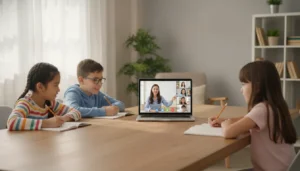
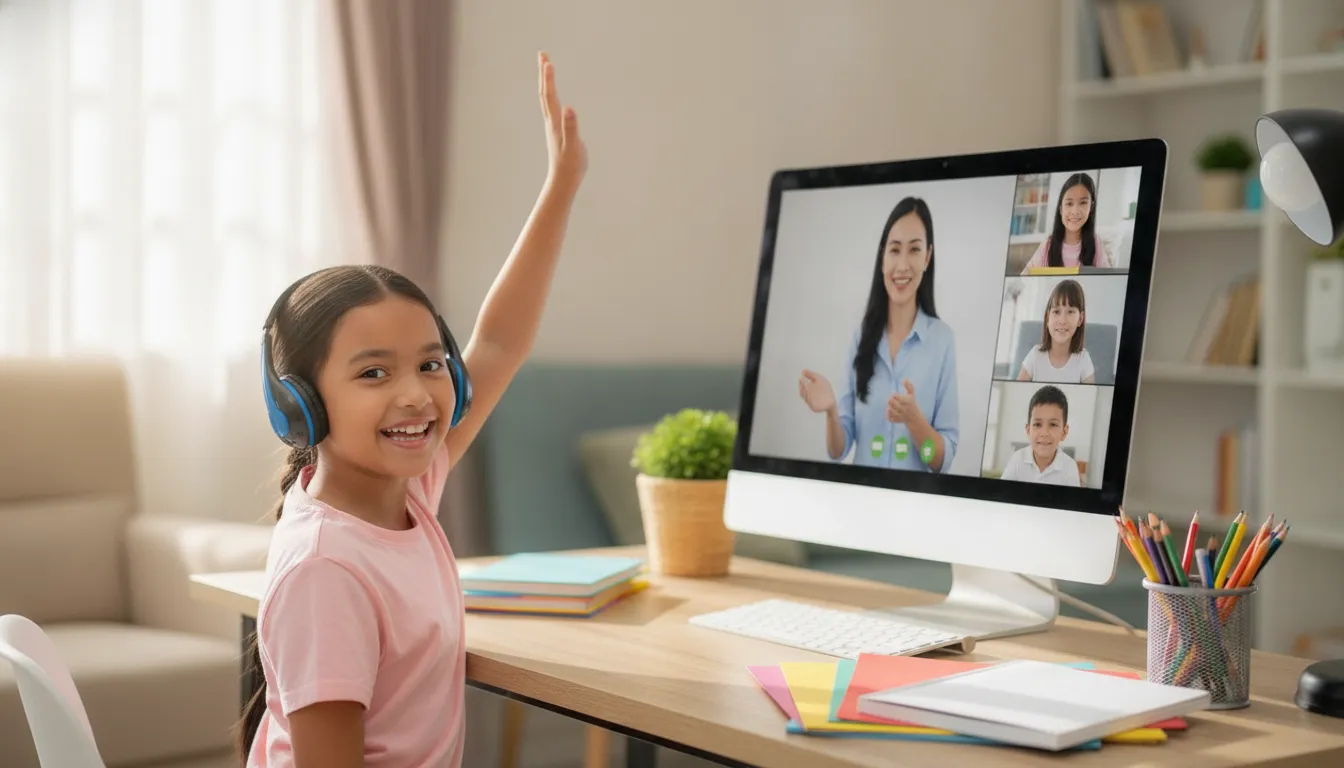
Live bilingual instruction is designed around participation, not passive screen time. Students join a virtual classroom where a teacher presents lessons, asks questions, models Spanish, and responds to students in real time. The goal is to make language part of the learning experience throughout the school day, rather than limiting it to isolated vocabulary exercises. A typical lesson may combine teacher explanation with screen sharing, an interactive whiteboard, visual prompts, and guided conversation. These tools give students multiple ways to connect meaning with language. A teacher might display a picture, demonstrate a math strategy, read a short passage, or model a science process. Then invite students to describe what they see and explain their thinking in Spanish or English, depending on the lesson objective. Live interaction helps the teacher notice confusion and adjust immediately. Small-group practice adds another important layer. Instead of listening to a teacher for the entire lesson. Students may work together in a breakout room or guided group to ask questions, role-play a conversation, solve a problem, or practice a new phrase. The teacher can move between groups, listen for pronunciation and comprehension, and provide personalized support. This real-time practice makes the online classroom more interactive and gives each student opportunities to speak. This approach reflects the principles behind two-way dual language immersion. In a balanced 50/50 model, students receive consistent exposure to both English and Spanish rather than treating Spanish as an occasional enrichment subject. Research on 50/50 dual language programs emphasizes that regular, balanced exposure supports progress toward bilingual proficiency (research on balanced language exposure). The exact schedule may vary by grade and program design, but the central idea is sustained use of both languages across academic and social learning. Comprehensible input, associated with language educator Dr. Stephen Krashen, provides a useful pedagogical foundation for this model. Students need to hear and interact with language that is understandable in context, while still offering an appropriate challenge. Gestures, images, demonstrations, repetition, and familiar routines help make new Spanish comprehensible. The teacher can then build on what students already understand instead of expecting them to translate every word before participating. Technology supports this instruction, but it does not replace the teacher. The value comes from the combination of a live educator, an interactive curriculum, structured exposure, and responsive feedback. To see a more detailed explanation, explore how our live dual language immersion works. Families comparing the accredited online bilingual elementary schools should ask how often students speak, how teachers personalize practice, and how English and Spanish are balanced throughout instruction.Curriculum and Teacher Quality: What to Evaluate
The difference between a self-paced Spanish course and a full online immersion school is not simply the amount of content available. It is the quality of the learning system around that content. Families should examine who teaches, how instruction is delivered, whether the curriculum follows a coherent K-12 progression, and how the program keeps students engaged over time. Teacher qualifications deserve particular attention in a virtual setting. Strong online immersion programs look for native-speaker proficiency, experience with remote teaching methods, and specialized K-12 certification. These factors help teachers model authentic language while adapting explanations, pacing, and activities for elementary learners. Live interaction also gives teachers opportunities to notice confusion and respond in the moment, rather than leaving students to work through a lesson alone. Learn more about how live dual-language instruction works.| What to evaluate | Consumer self-paced course | Accredited online immersion school |
|---|---|---|
| Instruction mode | Pre-recorded lessons and independent practice. Feedback and speaking opportunities may be limited. | Live, synchronous classes with direct teacher-student interaction, guided practice, and opportunities to use Spanish in real time. |
| Teachers | Instructor qualifications and elementary teaching experience can vary by provider. | Look for native-speaker proficiency, remote pedagogy experience, and specialized K-12 certification. These are core teacher-quality criteria. |
| Curriculum alignment | Often organized around language units or individual goals rather than a complete academic sequence. | Interactive lessons should align with K-12 academic expectations and connect language development with broader learning goals. |
| K-12 structure | May focus on a single age range or offer levels without a full school progression. | Provides a defined pathway across grade levels, with age-appropriate instruction and continuity as students advance. |
| Accreditation | May offer a completion certificate, but that is not necessarily school accreditation. | Should clearly identify its accrediting organization, scope, and relationship to the school program. Families should verify these details before enrolling. |
| Engagement | Progress depends heavily on a student’s independent motivation and family supervision. | Uses live discussion, interactive tools, structured practice, and teacher feedback to sustain participation and accountability. |
What Elementary Students Need From Their Online Immersion Program
Elementary students learn best when online immersion feels active, predictable, and appropriately challenging. A strong program should not treat a virtual classroom as a library of recorded videos or isolated worksheets. Instead, lessons should invite students to listen, speak, move between activities, and use Spanish for meaningful purposes. Interactive whiteboards, screen sharing, small-group practice, games, songs, and guided conversation can help maintain attention while giving teachers opportunities to notice confusion and respond in the moment.Age-appropriate lessons and daily language exposure
Young learners need lessons built around their developmental stage. Clear routines, visual cues, short activity changes, stories, demonstrations, and practical language tasks make it easier to participate without feeling overwhelmed. The content should also connect language learning to the wider elementary curriculum, rather than separating Spanish from academic growth. K-12 curriculum alignment is one of the key factors identified for effective online immersion programs, alongside certified teachers, live lessons, and proven engagement strategies. Consistency matters just as much as lesson design. Students need regular exposure to both Spanish and English so that vocabulary, listening comprehension, and confidence develop over time. Research on 50/50 dual language immersion indicates that consistent, balanced exposure supports progress toward bilingual proficiency. Families comparing accredited online bilingual elementary schools should ask how often students meet live, how languages are distributed across the week, and how instruction builds from one grade to the next.A supportive environment for speaking
Speaking a new language can feel intimidating, especially when students are still developing basic vocabulary. Synchronous interaction gives them a familiar setting for oral practice, immediate feedback, and encouragement from a teacher who can adjust the pace. Research has found that synchronous online teaching can significantly reduce foreign language anxiety in primary students: supportive real-time interaction can make language practice feel less threatening. Teachers should normalize mistakes, invite participation in different formats, and use small groups when students need a lower-pressure opportunity to speak.Parent support and a clear K-12 pathway
Parents should receive enough structure to support learning without having to become the classroom teacher. Helpful programs make schedules, expectations, assignments, and communication channels clear. They also provide a progression that connects elementary foundations with the skills students will need in later grades. Alignment with K-12 standards helps ensure that early Spanish instruction contributes to a coherent academic journey, rather than becoming a disconnected enrichment activity. When these elements work together, online immersion can offer elementary students the routine, interaction, and encouragement they need to grow as bilingual learners.How Ideal School Supports Elementary Spanish Immersion Students
For families seeking a structured alternative to self-paced language lessons, Ideal School provides live, online bilingual and dual-language instruction for students in K-12 elementary grades. The program uses a two-way dual language immersion approach, giving students meaningful opportunities to learn academic content and communicate in both English and Spanish. Because lessons take place live, students can interact directly with teachers instead of working through recorded videos or isolated exercises. This model is designed to make online immersion feel like a real classroom experience. Students participate in synchronous instruction with certified educators, use interactive learning tools, and practice language in real time. These features help online Spanish immersion provide the structure and engagement associated with traditional classroom immersion. While allowing families to access the program from anywhere in the United States. Ideal School is accredited by Cognia, giving families an additional quality marker when comparing full-day live bilingual program options.Live instruction with direct teacher engagement
Elementary students benefit from immediate feedback, clear explanations, and the opportunity to ask questions as learning happens. Ideal School’s personalized online environments encourage direct engagement between teachers and students, rather than treating every learner as if they need the same pace or support. Teachers can respond to student questions, guide practice, and help learners use Spanish in purposeful academic and conversational contexts. Interactive virtual classrooms can include screen sharing, digital whiteboards, and small-group practice. These tools give students regular chances to listen, speak, read, and respond. The result is a more active learning environment than a course built primarily around worksheets or independent vocabulary drills. Families can learn more about the school’s approach on the about Ideal School page and review the explanation of how dual-language immersion works online.A full-day pathway for families across the United States
Ideal School supports families who want Spanish immersion to be part of a complete elementary education, not an isolated after-school activity. Its full-day structure provides a consistent academic routine, while the K-12 pathway gives students room to continue developing their bilingual skills as they progress through school. This continuity can be especially valuable for families comparing Spanish immersion online school options and looking for a program that can grow with their students. For parents evaluating the best online Spanish immersion elementary school for their family, the key questions are practical: Is instruction live? Do teachers engage directly with students? Does the program provide a complete, academically structured pathway? Ideal School’s accredited, full-day, two-way immersion model is built around those priorities while serving families nationwide.Is Online Spanish Immersion Effective for Elementary Students?
Yes, online Spanish immersion can be effective for elementary students when it provides consistent language exposure. Live teacher interaction, and a curriculum designed for the developmental needs of young learners. The key difference is whether students actively use Spanish during structured lessons or simply complete isolated activities on a screen. Research on second-language immersion has found meaningful gains in executive functions, including cognitive flexibility and attention control, among elementary students. These skills can support how students switch between tasks, manage instructions, and approach problems across subjects. The findings do not mean that every online course produces the same result. They point to the value of sustained, well-designed immersion. Read the academic research on cognitive effects of second-language immersion.Why live interaction matters
Language develops through use. In a live virtual classroom, students can listen to a teacher, respond aloud, ask questions, and receive immediate feedback. Videoconferencing also allows elementary students to practice Spanish meaningfully with others despite geographic distance. Screen sharing, interactive whiteboards, and small-group activities can make the lesson collaborative rather than passive. This structure is especially important for oral communication. Students need regular opportunities to hear natural language and use it for a purpose, such as describing an idea, solving a problem, or participating in a conversation. A self-paced program may introduce vocabulary, but it cannot fully replace the responsiveness of a teacher who can adjust explanations and prompts in real time.What sustained immersion should include
Strong programs give students a clear progression instead of treating Spanish as an occasional enrichment activity. A two-way dual language model includes both English and Spanish in a balanced 50/50 approach, with consistent exposure supporting the development of bilingual proficiency. Two-way immersion research also associates the model with long-term academic benefits and stronger outcomes for diverse student populations. Families evaluating accredited online bilingual elementary schools should therefore look beyond the word “immersion.” Ask whether lessons are live, whether teachers are qualified to teach elementary students online. How often students speak Spanish, and whether the curriculum aligns with a broader K-12 pathway. Interactive instruction and structured exposure are central to the approach described in Ideal School’s explanation of online dual-language immersion. For families seeking a structured school experience rather than an occasional class, a full-day live bilingual program can provide the consistency that makes immersion more effective. The best choice is the program that combines academic continuity, meaningful daily practice, qualified teachers, and a supportive environment where elementary students feel comfortable using Spanish. Talk to the Ideal School team about enrolling your child in a live bilingual elementary program.Frequently Asked Questions
What should I look for in an online Spanish immersion elementary school?
Look for certified teachers with strong Spanish proficiency, experience teaching online, live interactive lessons, and a curriculum that aligns across K-12 grades. Small-group practice, clear progress expectations, and meaningful teacher-student interaction matter more than a library of prerecorded videos.Is online Spanish immersion effective for elementary students?
It can be effective when students receive consistent, structured exposure and actively use Spanish with a teacher and classmates. Live instruction, interactive curriculum, and guided practice create opportunities to listen, speak, and receive feedback in real time. Research on immersion also associates second-language learning with gains in cognitive flexibility and attention control (academic research).How does live bilingual instruction work online?
Students join a scheduled virtual classroom where the teacher explains concepts, shares materials, uses interactive whiteboards, and guides discussions or small-group activities. The live format allows the teacher to notice questions, adjust instruction, and give students immediate opportunities to practice both languages instead of relying only on independent worksheets.Are online Spanish immersion programs available for K-12 students?
Yes. Families should confirm that a program offers a continuous pathway rather than a short course designed for one age group. Ideal School provides live, online bilingual and dual-language instruction for K-12 students across the United States through a two-way immersion approach. Its about page provides additional program context.What makes a program a strong fit for elementary students?
Elementary students benefit from age-appropriate lessons, frequent interaction, predictable routines, and teachers who can balance academic goals with language practice. Ask how the school supports participation, monitors progress, communicates with families, and helps students move into more advanced coursework over time.Ready to Explore Spanish Immersion for Your Student?
Choosing a live bilingual program can help families compare instruction, curriculum, and support in the context of their student’s needs. Contact the Ideal School admissions team to learn more about how its online Spanish immersion program can support elementary students. Contact Ideal School to ask questions and discuss the next step for your family.
Written by
Eric C. Franzen
Eric C. Franzen is co-founder and owner of Ideal School, with 20+ years of experience as an educational leader and entrepreneur. He holds a BA in Education from the University of Washington and an MA in Educational Administration from Seattle Pacific University.
View LinkedIn Profile →