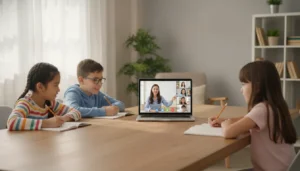




For some students, an online school works best when learning feels like a real class, not a list of videos and independent assignments. Live instruction creates a predictable point of connection, gives students a chance to ask questions, and lets teachers adjust their pace when a concept is unclear.
The best online high school for live classes combines consistent teacher-led instruction with meaningful interaction, timely feedback, and clear academic structure. Research suggests that synchronous learning can strengthen both engagement and learning outcomes, especially when students actively participate. See the findings in this academic review of synchronous online learning.
For parents, the right choice is not simply the school that advertises live classes. It is the provider that makes those classes purposeful, supportive, and aligned with the student’s broader goals. Start by looking at what happens during a typical session and how the program turns real-time interaction into lasting academic progress.
Schedule a free consultation to compare Ideal School’s live classes with other online programs.
What Makes an Online High School the Best Choice for Live Classes?
The best online high school for live classes is not simply a school that places recorded lessons on a learning platform. It provides a real classroom experience through scheduled, teacher-led instruction, meaningful participation, and opportunities to ask questions while learning is happening. Students can hear an explanation, respond to a prompt, and receive guidance without waiting for a teacher to review an assignment later.
This distinction matters because synchronous online learning can strengthen engagement through immediate interaction between instructors and students. Research published in Education Sciences connects synchronous courses with stronger engagement and academic outcomes than purely asynchronous approaches. A separate meta-analysis reported positive effects for synchronous learning across both cognitive and affective outcomes, including how students learn and how they experience the learning process. The ERIC-indexed research supports evaluating live instruction as more than a scheduling preference.
Look for instruction, not just access to coursework
Automated self-paced modules may offer flexibility, but they can leave students working through concepts without enough interaction. For students who need accountability, discussion, or clarification, the stronger choice is a school where live instruction is central to the academic model. The teacher should explain new material, invite students into the lesson, monitor understanding, and respond when a concept needs a different explanation.
That does not mean every part of the school day must happen on camera. Strong programs can combine live lessons with independent practice, assignments, and review. The important question is whether those independent activities support teacher-led learning or replace it. A program built primarily around automated modules may look convenient while offering less opportunity for connection and timely guidance.
Prioritize a structured, responsive school day
Families should also ask how live classes fit into the broader school experience. A dependable schedule gives students a clear rhythm for attending class, completing work, and preparing for the next lesson. Within that structure, teachers can adjust the pace when students need more explanation rather than relying on a fixed sequence of screens or videos.
Ideal School’s full day online high school program is designed around a structured environment and direct instruction for K-12 students. For families comparing providers, that model illustrates the core standard to look for: live classes should be part of an intentional academic program, not an occasional add-on. The right fit is a school where students are taught by educators, expected to participate, and supported throughout the learning process.
Why Live Online Classes Beat Self-Paced Courses for Many Students
Self-paced courses can look flexible, but flexibility is not the same as support. For many high school students, recorded lessons and automated modules make it easy to postpone difficult work. Lose track of deadlines, or continue studying without knowing whether they truly understand the material. Live online classes provide a dependable framework that turns learning into a regular part of the day.
| Feature | Live Online Classes | Self-Paced Courses |
|---|---|---|
| Schedule | A fixed, recurring class time each day | Students choose when to study |
| Teacher contact | Real-time instruction and immediate answers | Limited or delayed support |
| Feedback | Teachers respond to questions during the lesson | Feedback often comes after graded work |
| Pacing | Teachers adjust the pace when the class needs more explanation | A fixed, pre-recorded sequence |
| Accountability | Routine, attendance, and regular participation | Students must manage their own momentum |
| Community | Interaction with teachers and classmates in real time | Little social presence |
Routine makes time management more manageable
A predictable class schedule gives students a clear starting point and a series of built-in commitments. Instead of deciding when to watch a lesson, complete an assignment, or move to the next unit, they can organize their study time around live instruction. This structure is especially valuable for students who struggle with time management in self-paced environments. US News identifies predictable scheduling as a key benefit of synchronous online classes.
Routine also creates accountability. A student joins class at a set time, participates, and receives assignments within an established course rhythm. That does not remove the need for independence, but it gives independence a reliable foundation. Teachers and families can notice missed sessions, incomplete work, or a sudden change in participation before a small problem becomes a larger academic gap.
Immediate feedback prevents confusion from piling up
In a pre-recorded course, a student may replay a video several times and still be unsure what to do next. A live teacher can respond to a question as it arises, clarify a difficult idea, and adjust the pace when students need more explanation. To see the bigger picture, many families start by reading how online high schools compare to traditional education. Research on synchronous learning notes that live sessions allow immediate adjustments based on student feedback. This makes instruction more responsive than a fixed sequence of recorded content.
Real-time interaction also gives teachers more opportunities to identify confusion. A question, hesitant response, or change in participation can signal that a student needs another example or a different explanation. Students do not have to wait for a graded assignment to discover that they misunderstood an important concept.
Social learning can strengthen motivation
Learning alongside teachers and classmates adds a social context that self-paced modules cannot fully reproduce. Students hear questions from peers, contribute their own ideas, and experience progress as part of a shared class. Research has linked the interactive and social nature of synchronous learning with stronger student motivation. That connection matters because persistence often depends on feeling engaged, noticed, and connected to the work.
For families comparing programs, the best online high school for live classes is not simply the one with the most digital lessons. It is the one that combines a consistent schedule, active teacher presence, responsive pacing, and meaningful participation. Self-paced resources can still support review, but live instruction gives many students the structure and human interaction they need to keep moving forward.
Five Things to Look for in an Online High School Today
A strong online high school should offer more than a video library and a list of assignments. If your student needs live classes, evaluate how the school delivers instruction, supports progress, and communicates with your family. Use this checklist when comparing programs:
- Accreditation you can verify. Accreditation is an important quality signal because it indicates that a school meets established academic standards and may help ensure credits are accepted by colleges. Ask which organization accredits the school, confirm the relationship on the accreditor’s website, and check whether the accreditation applies to the program your student will attend. Ideal School is a Cognia-accredited online high school.
- Certified teachers who are present in real time. A live schedule only has value when qualified teachers lead the learning. Look for instructors who explain concepts, invite questions, monitor participation, and adjust the pace when students need more support. Ask whether teachers are responsible for direct instruction or whether most lessons are automated modules with occasional help available.
- A student-to-teacher ratio that supports interaction. Class size affects how much individual attention a teacher can provide. A lower student-to-teacher ratio often creates more opportunities for questions, discussion, and timely feedback. Ask how many students typically attend each live class, whether students can speak directly with the teacher, and how the school identifies students who are falling behind. The ratio matters most when it translates into meaningful interaction, not simply a number in a brochure. Research online-school ratios as part of your comparison.
- Clear alignment with graduation requirements. Before enrolling, confirm that the curriculum and credits align with the graduation requirements that apply to your student. Requirements can vary by state, so ask the school for specific guidance about required courses, credit transfer, transcripts, and graduation planning. A school should be able to explain how it tracks progress toward completion rather than leaving families to interpret requirements alone.
- Interactive technology and dependable communication. The platform should make live learning practical, not frustrating. Look for tools that support teacher interaction, participation, assignments, course materials, and grades in one organized experience. Ask for the technical requirements before enrollment, including device, internet, microphone, and camera expectations. Then clarify how teachers, students, and parents communicate outside class. Clear channels for questions, progress updates, conferences, and urgent concerns help families respond before a small issue becomes a larger learning gap.
As you compare options, request a sample schedule or demonstration of a live class. You should be able to see how the school combines qualified instruction, manageable class interaction, academic oversight, and practical family support. Those details reveal whether a program is genuinely built for live learning or simply adds occasional video meetings to a self-paced course.
How Ideal School Delivers Live, Teacher-Led Classes
Families searching for the best online high school for live classes often want more than a video library and a list of assignments. They want a school day with clear structure, direct access to teachers, and instruction that responds to the student in front of the screen. Ideal School is designed around that synchronous experience.
Its full day online high school program provides a structured setting for K-12 students. Rather than placing the full responsibility for pacing and daily organization on the family, the program centers learning around scheduled, teacher-led instruction. Students can ask questions, participate in the lesson, and receive guidance while the class is taking place.
Direct instruction throughout a structured school day
Ideal School’s synchronous online classes are intended for students who need direct interaction with an instructor. That matters when a concept is difficult, an assignment needs clarification, or a student benefits from a different explanation. Live instruction gives teachers the opportunity to respond to what students are demonstrating in real time, instead of relying only on automated modules or pre-recorded material.
This approach also creates a predictable rhythm. A full-day program can help separate school time from the rest of the day and give students regular opportunities to engage with teachers and classmates. For families comparing online options, the key question is not simply whether a school uses technology. It is whether technology supports an actual instructional relationship.
Support beyond the scheduled class
Live classes are strongest when students have support available beyond the main lesson. Ideal School offers personalized tutoring support for students who need additional academic assistance. Tutoring can provide focused help with a challenging subject or reinforce material introduced during the regular school day. Families who want flexibility without giving up teacher-led learning can also explore the school’s supplemental homeschool classes.
The school’s live language learning institute adds another option for structured, synchronous instruction. It provides language learning for students at different proficiency levels, extending the benefits of real-time teaching into specialized study.
Ideal School also presents transparent tuition plans, giving families clearer information as they compare the total value of a live program. Its accreditation through Cognia provides an additional quality signal for families evaluating private online schools. Together, scheduled instruction, targeted support, specialized live learning, and visible tuition information create a more complete alternative to self-paced coursework.
Will a Live Online High School Give My Student the Community They Need?
For many families, choosing an online high school raises an understandable concern: will a student feel connected, or will learning happen alone behind a screen? A well-designed live program can provide meaningful relationships with teachers and classmates because students share a learning space in real time. They can hear one another, respond to questions, work through challenges together, and build familiarity over the course of the school year.
That real-time interaction can foster a sense of community and reduce feelings of isolation among online students, according to research on synchronous learning. The goal is not to copy every feature of a traditional campus. It is to create consistent opportunities for students to participate, be known, and contribute. For a student who needs encouragement, structure, or the simple reassurance that others are learning alongside them, that difference matters.
Connection happens through regular participation
Community is built through repeated, ordinary moments. A student asks a question during class and receives an answer. A teacher notices confusion and adjusts the explanation. Classmates compare ideas, complete a shared activity, or encourage one another through a difficult assignment. These interactions help students experience school as a relationship, not merely a collection of lessons to complete.
Live classes also give teachers more opportunities to understand how students are doing. Facial expressions, questions, participation, and changes in energy can provide useful context that is difficult to capture in a fully self-paced course. That visibility does not guarantee that every student will participate immediately. But it gives teachers a chance to invite participation and offer support before a student feels completely disconnected.
Social-emotional learning needs a social setting
Academic progress is only part of a student’s school experience. Students also practice communication, listening, collaboration, self-advocacy, and persistence. Research summarized in the fact ledger indicates that social-emotional learning is more effectively supported when students have regular live interaction with peers and instructors. In other words, the live classroom can be a place where students develop confidence and interpersonal skills while they learn subject content.
Families should ask how a school turns that potential into daily practice. Look for teacher-led discussion, collaborative work, and clear expectations for respectful participation. A community does not require every student to be highly outgoing. It requires a school culture where students have safe, recurring ways to speak, listen, ask for help, and work with others.
Extracurricular experiences extend the community
Community should not end when the class period does. Synchronous extracurricular activities can give students additional ways to pursue interests and connect with peers outside their regular coursework. These opportunities may be especially valuable for students who are learning from home and want a broader sense of belonging. When evaluating a program, ask which activities are offered live, how students participate, and whether teachers provide guidance during those experiences.
The best fit is a school that treats connection as part of education rather than an optional extra. With live instruction, intentional social-emotional support, and synchronous extracurricular opportunities, an online high school can give students a community that feels active, personal, and dependable.
Is an Online High School with Live Classes a Real, Accredited School?
Yes, an online school can be a real high school, but live video classes alone do not establish that it is accredited. Families should look beyond a polished platform or a full schedule and confirm who recognizes the school. What standards it follows, and how its credits can support a student’s next academic step.
Accreditation is an external quality review. An accrediting organization evaluates whether a school meets established expectations for areas such as curriculum, instruction, student services, and academic operations. It is an important signal that the program is operating as a school rather than simply selling access to online courses. Accreditation can also help colleges and other schools evaluate whether credits were earned through a credible academic program. However, accreditation is not an automatic promise of admission or universal credit acceptance. Families should still ask prospective colleges or receiving schools how they review transfer credits and transcripts.
What accreditation means for credits and college planning
When comparing programs, ask specific questions before enrolling. Which organization provides the accreditation? Is the accreditation current? Does the school issue an official transcript? How are course credits earned, documented, and aligned with applicable graduation requirements? These questions matter because a program may offer live instruction without providing the academic records a student needs later.
It is also useful to request the school’s policies in writing. Ask how attendance is recorded, how assessments are administered, and who can answer questions about transcripts or credit transfer. A credible school should be able to explain its academic process clearly instead of treating accreditation as a vague marketing label. The Education Resources Information Center overview of online high schools identifies accreditation as a crucial indicator of quality and credit acceptance. Families should use that guidance as a starting point for their own verification.
How to verify an online school’s status
Start with the school’s official website, then confirm the accreditor independently through its own directory or public records. Look for the school name, current status, and scope of the accreditation. If the information is unclear, contact the school and ask for the accreditor’s exact name and a link to the accrediting organization’s listing. Be cautious of uncheckable claims, expired notices, or language that confuses approval, membership, licensing, and accreditation.
Ideal School is accredited by Cognia. Families can review the school’s accreditation information on the Cognia-accredited online high school page, then discuss transcript and enrollment questions directly with the school. That verification step helps parents judge whether a live program is both engaging day to day and appropriately structured for the student’s longer-term academic goals.
Talk to Ideal School about enrollment and whether live classes fit your student’s goals.
Frequently Asked Questions
What makes an online high school reputable?
Start with accreditation, qualified teachers, and a clear academic program. Accreditation indicates that a school meets established quality standards and that its credits may be accepted by colleges. Parents should also ask how often teachers interact with students, how progress is reported, and what support is available when a student needs additional help. Source: ERIC.
How are live classes different from self-paced courses?
Live classes give students a scheduled place to ask questions, receive clarification, and respond to teacher feedback in real time. They also create a predictable routine, while self-paced courses place more responsibility on the student to organize each day. A strong program may still provide recordings so students can review difficult concepts after class. Sources: PMC; U.S. News.
How many live classes should an online high school offer?
There is no single number that fits every student, but families should look for a consistent schedule with regular teacher contact rather than occasional optional meetings. Ask whether core subjects meet live, whether attendance is expected, and how teachers adjust the pace when students are confused. The goal is enough direct instruction and accountability to support learning without creating an unmanageable schedule.
What should parents check before enrolling?
Confirm the school’s accreditation, curriculum alignment with your state’s graduation requirements, teacher qualifications, class size, technology requirements, communication process, and student support services. It is also worth asking how the school builds community and whether students can participate in collaborative or extracurricular activities. Reviewing the online portal and understanding how assignments, grades, and recordings are organized can help you judge the day-to-day experience.
Ready to Explore the Best Online High School for Live Classes?
Choosing a live, teacher-led program is an important decision for your student. A conversation with Ideal School can help you consider whether its synchronous approach, structured learning environment, and available support match your family’s needs.
Schedule a free consultation with Ideal School today

Written by
Eric C. Franzen
Eric C. Franzen is co-founder and owner of Ideal School, with 20+ years of experience as an educational leader and entrepreneur. He holds a BA in Education from the University of Washington and an MA in Educational Administration from Seattle Pacific University.
View LinkedIn Profile →