


Virginia Homeschool Laws and Requirements for Families
If you are researching Virginia homeschool laws, the first thing to know is that the state gives families several legal paths. The most common route is home instruction under Virginia Code Section 22.1-254.1, but families may also consider a religious exemption, private school enrollment, or an approved correspondence school. Each option has different paperwork, deadlines, and responsibilities.
Need structured academic support while you homeschool? Explore Ideal School’s supplemental homeschool classes for live, teacher-led instruction in core subjects.
This guide explains Virginia homeschool requirements in plain language. You will learn who must comply, how to file a notice of intent, what curriculum information to provide, which annual assessment options are allowed, what records to keep, and how an accredited online school or supplemental classes can fit into your plan.
This article is an educational overview, not legal advice. Before making decisions, review the Virginia Department of Education home instruction page, the current Virginia home instruction statute, and your local school division’s filing instructions.
Quick Answer: What Are Virginia Homeschool Laws?
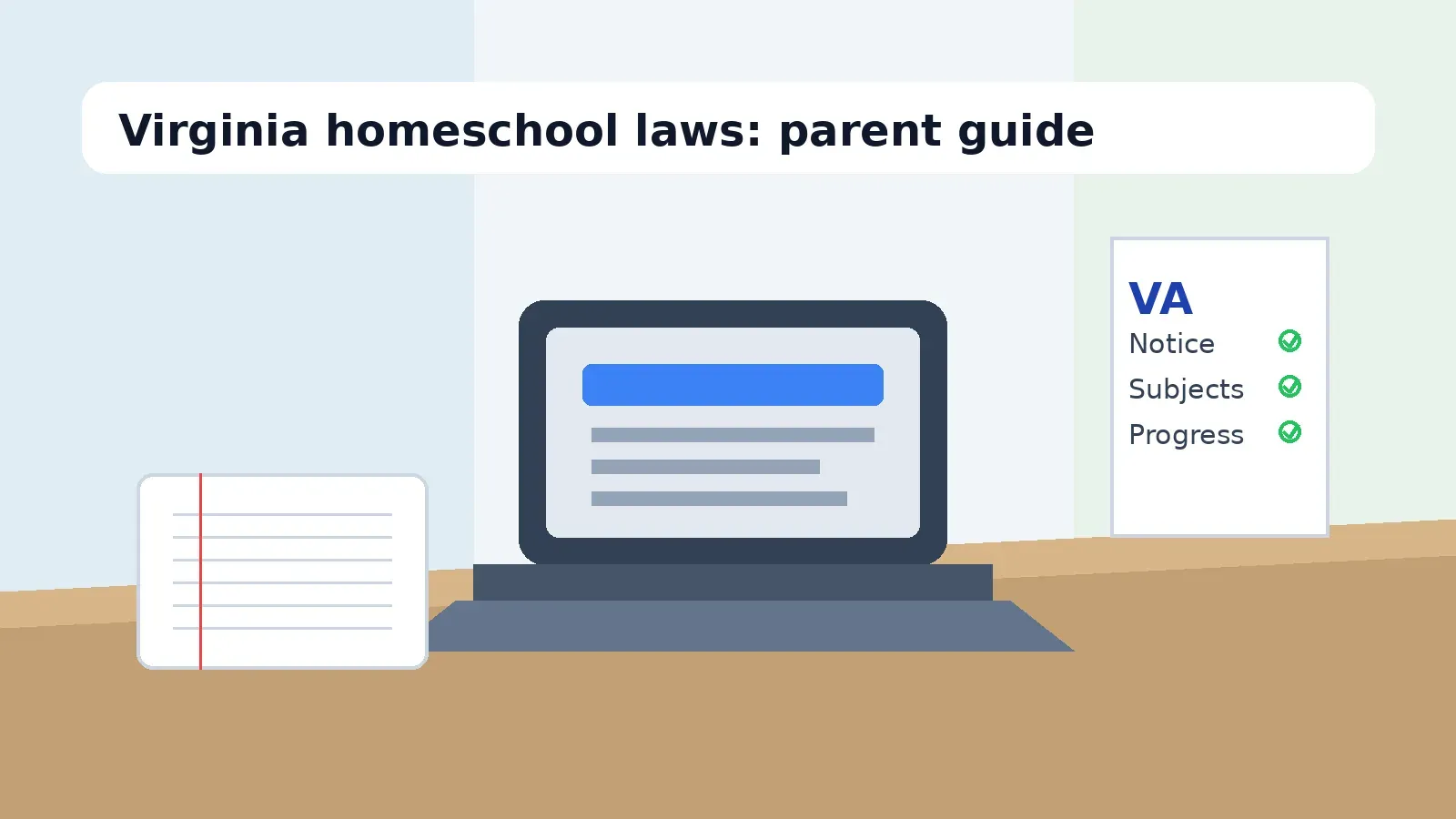
Virginia allows parents to educate at home when they satisfy one of the state’s recognized attendance alternatives. Under the home instruction statute, a parent files annual notice with the local division superintendent, provides evidence that the parent qualifies to offer home instruction, lists the subjects to be studied, and submits evidence of academic progress by the annual deadline.
The core Virginia homeschool requirements are:
- Compulsory attendance applies to children who have reached their fifth birthday on or before September 30 of the school year and have not passed their eighteenth birthday.
- Notice of intent is due by August 15 for families using the home instruction statute before the school year begins.
- New homeschoolers or families who move midyear should notify the school division as soon as practicable and then comply with the law within 30 days.
- Parents must show one qualifying basis, such as a high school diploma, teacher qualifications, a program of study or curriculum, or evidence of ability to provide an adequate education.
- Parents must submit a subject list for the coming year.
- Evidence of progress is due by August 1 after the school year, unless a specific exception applies.
In short, Virginia homeschooling is flexible, but it is not paperwork-free. The state expects families to choose a legal pathway, file on time, teach a real course of study, and show progress each year.
Who Must Follow Virginia Compulsory Attendance Rules?
Virginia’s compulsory attendance rules generally apply to children who will be age 5 on or before September 30 of the school year and who have not passed age 18. Families who do not enroll in public or private school need to use one of the legal alternatives recognized under Virginia law.
For many families, that alternative is home instruction. Others may use a private school option, an approved correspondence course, or a religious exemption. The correct path depends on your family’s beliefs, educational goals, and documentation.
If your child is younger than compulsory attendance age, some annual progress requirements may not apply. If your child is close to graduation, high school planning, transcripts, credits, and college readiness become more important than simple attendance compliance.
The Main Virginia Homeschool Pathways
Virginia families often use the word homeschool broadly, but the legal pathways are not identical. Understanding the differences can help you avoid filing the wrong form or assuming one option has the same requirements as another.
Home Instruction Under Virginia Code Section 22.1-254.1
Home instruction is the pathway most families mean when they talk about Virginia homeschool laws. Under this option, the parent provides instruction and files with the local school division. The parent must provide annual notice, evidence of qualification, a list of subjects, and annual evidence of progress.
This route offers flexibility. The law allows curriculum to be delivered through a correspondence course, distance learning program, or another manner. That means families can combine parent-led instruction, online courses, tutoring, textbooks, co-ops, and live classes as long as the parent remains responsible for meeting Virginia’s requirements.
Religious Exemption
Virginia law also recognizes an excuse from school attendance for bona fide religious training or belief. This is a separate pathway from ordinary home instruction. Families seeking a religious exemption usually apply through their local school board and should be prepared to explain how school attendance conflicts with sincerely held religious beliefs.
Approved Correspondence Course
Virginia’s compulsory attendance law also references an approved correspondence course as an alternative. Families sometimes confuse a general online curriculum with an approved correspondence school. A program may be online and useful, but that does not automatically mean the state or local division treats it as an approved correspondence course for attendance purposes.
Private School Enrollment
Some families enroll in a private school that delivers instruction online. This can be different from filing as a homeschool family under home instruction. A private school may provide courses, teachers, transcripts, grades, and a school structure, while parents still manage the home learning environment.
Ideal School’s Full Day Program is a live online private school option for families who want daily teacher-led classes, bilingual instruction, and a complete academic schedule. Families should still confirm how private online enrollment interacts with their local attendance obligations.
How to File a Virginia Notice of Intent
For home instruction, Virginia requires parents to notify the local division superintendent annually. The Virginia Department of Education says families should submit the required documentation to their local school division.
The annual notice is generally due by August 15. If you move into a school division or begin home instruction after the school year has already started, notify the division as soon as practicable and then comply with the law within 30 days of that notice.
Your notice of intent package usually includes:
- The student’s name, age, and address, as requested by the local form
- A statement that you intend to provide home instruction
- Evidence that you meet one of the four parent qualification options
- A list of subjects the student will study during the coming school year
Virginia provides a sample notice of intent, and many school divisions publish their own forms. Use the current version from the state or your local division rather than an old template from a random website.
What Are the Four Parent Qualification Options?
Under the home instruction statute, a parent can qualify to provide home instruction in one of four ways. You only need to meet one option, but you should provide clear evidence with your notice.
| Option | What It Means | Common Documentation |
|---|---|---|
| Option I | The parent holds a high school diploma or higher credential. | Diploma, transcript, GED, or college degree. |
| Option II | The parent meets teacher qualifications prescribed by the Virginia Board of Education. | Teaching license or other accepted qualification evidence. |
| Option III | The parent provides a program of study or curriculum. | Curriculum description, online program details, course list, or distance learning plan. |
| Option IV | The parent provides evidence of ability to provide an adequate education. | Educational plan, resources, experience, or other supporting evidence. |
Many families use Option I because it is straightforward. Other families use Option III when they want the curriculum itself to show that the educational plan is adequate. An online program, live classes, or supplemental courses may be part of that evidence, but the local division may still ask for a clear subject list.
What Curriculum Information Does Virginia Require?
Virginia does not require parents to submit every lesson, textbook page, assignment, or daily schedule with the notice of intent. The statute describes the curriculum description as limited to a list of subjects to be studied during the coming year.
A simple subject list might include English language arts, mathematics, science, social studies or history, Spanish or another world language, art, music, physical education, technology, or electives. Some families include brief curriculum names or course descriptions to make the plan clearer.
Ideal School’s model can support this planning because students can take live classes in core subjects. Families using home instruction may choose supplemental homeschool classes for selected subjects or use a broader online school plan if they want more structure.
Annual Assessment and Evidence of Progress
Virginia requires families using home instruction to submit evidence of academic progress by August 1 after the school year. This is one of the most important deadlines in Virginia homeschool laws because missing it can put the home instruction program at risk.
Standardized Testing
One option is to provide evidence that the student achieved a composite score in or above the fourth stanine on a nationally normed standardized achievement test. The statute also recognizes equivalent scores on the ACT, SAT, or PSAT.
Evaluation or Assessment
Another option is to provide an evaluation or assessment that the division superintendent determines shows adequate educational growth and progress. Virginia lists examples such as an evaluation letter from a licensed teacher, an evaluation letter from a person with a master’s degree or higher in an academic discipline who knows the student’s academic progress, or a report card or transcript from certain educational providers.
Want live classes that produce clearer academic records? Read Ideal School’s guide to online homeschooling to compare parent-led, supplemental, and full online school options.
What Happens If Evidence of Progress Is Missing or Too Low?
If the required evidence of progress is not provided, or if the evidence does not show adequate progress, Virginia law allows the home instruction program to be placed on probation for one year. During that period, parents may need to submit evidence of their ability to provide an adequate education and a remediation plan designed to address the educational deficiency.
If the remediation plan and evidence are accepted, home instruction may continue during the probationary year. If the plan is not accepted, or if progress evidence is still not provided by the next August 1 deadline, home instruction may have to cease and the parent must make other legal educational arrangements.
What Records Should Virginia Homeschool Families Keep?
Virginia’s home instruction statute focuses on notice, subject lists, qualification evidence, and annual progress. Still, strong records protect your family and make transitions easier. Good documentation is especially important for high school students, students receiving services, and families who may return to public or private school later.
Consider keeping copies of every notice of intent, the annual subject list, curriculum plans, work samples, grades, standardized test results, evaluation letters, report cards, transcripts, outside class records, and high school course descriptions. For high school, create a transcript as you go rather than trying to reconstruct several years of coursework at graduation.
How Do Virginia Homeschool Laws Apply to Special Education?
Families sometimes ask whether homeschooling changes special education rights. The answer depends on the pathway, the student’s status, and the services requested. Public school services connected to an IEP may not continue in the same way once a student is homeschooled or privately educated.
If your student has an IEP, 504 plan, therapy needs, gifted services, or learning differences, talk with the local school division before withdrawing. Ask what evaluations, services, consultation, or documentation may remain available. Online classes can be useful for structure, but they are not a substitute for a formal special education plan unless the provider specifically offers those services.
Can Online Classes Count Toward a Virginia Homeschool Plan?
Yes, online classes can usually be part of a Virginia homeschool plan under the home instruction pathway. The statute specifically allows a program of study or curriculum to be delivered through a correspondence course, distance learning program, or another manner. That gives families room to use online curriculum, live virtual classes, tutoring, or a full online school schedule.
The key is to understand who is responsible for compliance. If you file as a home instruction family, the parent remains responsible for notice, subject lists, and annual evidence of progress. An online provider can supply instruction, grades, course structure, or transcripts, but parents should keep copies and submit the required materials on time.
Ideal School may fit in several ways: supplemental support for subjects that are harder to teach at home, a full-day online school schedule, bilingual academic instruction, and structured records that can support progress documentation.
Step-by-Step Checklist for Homeschooling in Virginia
- Choose your legal pathway. Decide whether you are using home instruction, private school enrollment, religious exemption, or another recognized option.
- Review current state and local guidance. Read the Virginia Department of Education page and your school division’s homeschool instructions.
- Prepare parent qualification evidence. Choose one of the four home instruction qualification options and gather documentation.
- Create a subject list. List the subjects your student will study during the coming school year.
- File notice by August 15. Submit the notice of intent and supporting materials to your local division superintendent.
- Keep copies. Save your notice, subject list, curriculum plan, and any confirmation from the division.
- Teach and document learning. Keep work samples, grades, learning logs, and outside course records.
- Plan assessment early. Decide whether you will use standardized testing, an evaluator letter, or another accepted assessment route.
- Submit evidence of progress by August 1. Send results or evaluation documentation before the deadline.
- Update next year’s plan. Use what worked, adjust what did not, and prepare the next annual notice.
Common Mistakes to Avoid
- Missing the August 15 notice deadline. Put it on your calendar several weeks early.
- Forgetting the August 1 progress deadline. This deadline comes before the next notice deadline.
- Sending too little qualification evidence. Make it easy for the division to see which option you are using.
- Confusing online curriculum with private school enrollment. Know whether you are filing as a homeschool family or enrolling in a school.
- Waiting too long to plan high school records. Transcripts, credits, and graduation requirements are easier to manage from the start.
- Assuming special education services stay the same. Ask the local division how services work after withdrawal.
Considering a more structured school week? Request more information from Ideal School to discuss full-day online school, supplemental homeschool classes, and bilingual learning options.
FAQ About Virginia Homeschool Laws
Do Virginia parents need permission to homeschool?
Families using the home instruction option must notify the local division superintendent and provide the required documentation. The process is not the same as asking the school to design your program, but you do need to satisfy the statutory requirements.
When is the Virginia homeschool notice of intent due?
The annual notice of intent is generally due by August 15. If you begin after the school year starts or move into a new division, notify the division as soon as practicable and comply with the law within 30 days.
What subjects are required for Virginia homeschoolers?
Virginia asks for a list of subjects to be studied, rather than a full lesson-by-lesson curriculum. Families commonly include English language arts, math, science, social studies, world language, and electives appropriate to the student’s grade level.
Does Virginia require annual testing for homeschoolers?
Virginia requires annual evidence of progress for most home instruction families, but that does not always have to be standardized testing. Parents may use qualifying test scores or an accepted evaluation or assessment, such as an evaluator letter or report card from certain educational providers.
Can an online school be used for homeschooling in Virginia?
Yes, online courses can be part of a Virginia home instruction plan. Parents should clarify whether the online provider is being used as curriculum support, a correspondence program, or private school enrollment, because each arrangement may affect documentation and responsibility.
Final Thoughts on Homeschooling in Virginia
Virginia gives families meaningful flexibility, but successful homeschooling starts with understanding the legal pathway. File your notice on time, keep your subject list clear, choose curriculum that fits your student, document learning, and plan annual progress evidence well before the deadline.
For families who want more structure, live instruction, or bilingual academic support, Ideal School can be part of the solution. You can choose supplemental classes for specific subjects or explore a full-day online school program that provides a consistent schedule, teacher interaction, and a broader learning community.
Review Ideal School tuition options or request more information to find the format that fits your family’s homeschool plan.