


Families searching for home school como funciona often want to understand what a school day actually looks like when a student learns at home. The answer depends on the arrangement: some families manage the learning plan themselves, while others enroll in an online school that provides teachers, classes, and academic structure. Knowing who handles each part makes it easier to compare options and plan a realistic week.
Ask about the online school program
What does home-based learning through an online school mean?
In an online school, the student attends school from home, but the school provides organized instruction. Teachers lead lessons, assign or guide academic work, and communicate expectations through the school’s learning systems. The family helps the student be ready to participate and provides a place and routine for learning. The exact division of responsibilities varies, so families should ask about attendance, assignments, adult supervision, and help with coursework.
This is different from parent-directed home education, where a parent or guardian chooses and manages the learning plan. There are also families who combine home education with individual online classes. Those arrangements are not interchangeable. Before comparing programs, write down who will select materials, teach each subject, track progress, and maintain any required documentation. For location-specific obligations, consult the appropriate local authority; the U.S. Department of Education provides federal education information, but does not replace state or local guidance.
Ideal School is an internationally accredited online K-12 private school. Its full-day program provides live virtual instruction in English Language Arts, Spanish Language Arts, Mathematics, Science, and Social Studies. Families can review the full-day program details and the school’s accreditation information to understand the school-based model.
How can a typical online school day work?
There is no single schedule for every online school. Some schools require students to attend live classes at set times. Others rely more on self-directed study. Ideal School describes daily synchronous instruction using Google Education technology, with a school day of approximately five hours and 45 minutes. Ask for the current schedule for the student’s grade, including local start and end times, before building family plans around it.
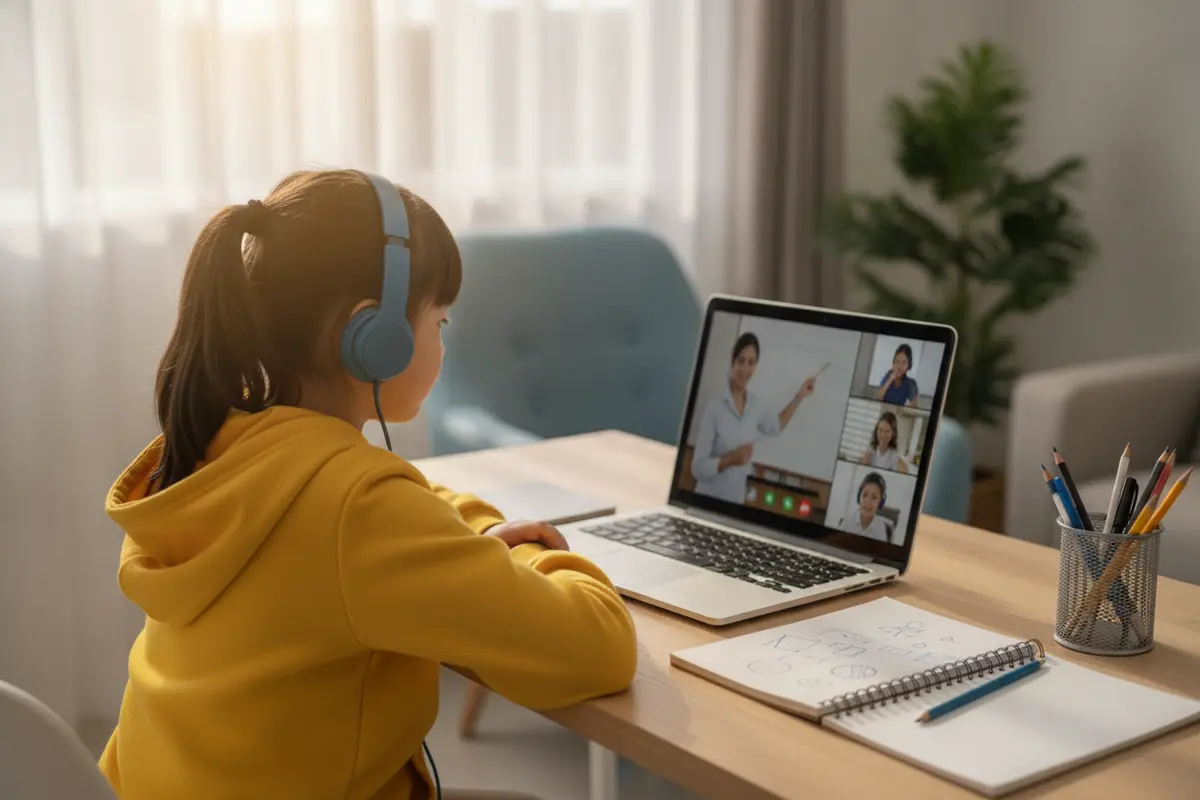
Live instruction means students meet with a teacher and classmates in real time. A student may listen, answer questions, discuss a topic, and complete activities during the class. Participation expectations differ by grade and course. Ask how attendance is recorded, what a student should do after a missed session, whether missed work can be completed later, and which person to contact if the classroom link or device fails.
Families should distinguish an advertised daily duration from time spent on every activity. Ask whether the stated school day includes breaks, transitions, independent work, and support periods. Find out how much work is expected outside scheduled classes. These questions help prevent a mismatch between the school’s timetable and a family’s work, care, or travel commitments.
What should a family prepare at home?
A useful learning space can be simple. It should help the student see and hear instruction, keep materials close, and reduce avoidable interruptions. Before the first day, consider these practical basics:
- A reliable internet connection and a computer or tablet suitable for the school’s platforms.
- Headphones or a quieter corner if other household activity makes listening difficult.
- A table or desk, writing supplies, and a consistent place for books and assignments.
- A visible schedule that separates live class time, breaks, and independent tasks.
- A plan for adult assistance, particularly for younger students who may need help signing in or organizing the day.
- A backup plan for a power or internet interruption, including how to notify the school and retrieve missed instructions.
Test the device, camera, audio, and classroom access before the first scheduled session. Ask which browser, applications, and device specifications are needed rather than buying equipment based on a guess. Ideal School’s tutorial videos and resources can help families become familiar with platform tasks. Clarify whether the student must keep the camera on, how to protect login details, and how the school handles technical support.

How do the main learning formats compare?
The central comparison is not simply where the student sits. Consider who teaches, how complete the program is, and how much coordination falls to the family. The table is a starting point; schools may use different labels, so confirm specific terms in writing.
| Format | Who organizes instruction? | What families should verify |
|---|---|---|
| Full-time online school | The school provides a complete program with teachers and an academic schedule. | Subjects, class times, attendance, family role, records, support, and full fees. |
| Individual online classes | Teachers provide selected subjects; the family coordinates the broader plan. | Available subjects, eligible grades, meeting format, progress reporting, and what fills the remaining study time. |
| Parent-directed home education | The parent or guardian selects and manages the learning plan. | Local requirements, curriculum choices, assessments, documentation, and teaching time. |
For example, a family that needs a teacher-led schedule across core subjects may prefer to investigate a full-time school. A family that already has a broader plan and needs instruction in one subject may explore a supplemental class. A parent who wants to choose all materials and manage lessons may be considering a different arrangement altogether. Compare the responsibilities, not just the names used in advertisements.
How should families compare tuition and total cost?
Compare the full cost over the same period. Ask whether tuition is monthly or annual, which one-time charges apply, and whether books, assessments, technology, or other materials are separate. Confirm due dates, payment methods, withdrawal terms, and any funding rules that might apply to your circumstances. Never assume that a funding program available in one location applies in another.
Ideal School publishes current tuition and pricing information. Read the price alongside the program description, and contact the school if you need help understanding what a listed amount includes. To compare two options carefully, calculate the full-year total: recurring tuition multiplied by the number of payments, plus required one-time fees and any separate materials. If a fee is optional, ask what the student can do without it.
Make a short comparison sheet with columns for tuition, one-time costs, included materials, payment schedule, and withdrawal conditions. This prevents a low monthly figure from overshadowing a larger initial charge or a service difference. Request current terms directly, since pricing and program details can change.
What should families ask about the student’s fit?
Start with the student’s grade, academic needs, language goals, and ability to manage online participation. Then consider the hours an adult can be available at home. A program may look appealing on paper yet be difficult to use if its live schedule conflicts with the family’s time zone or the student’s daily needs.
Use a structured question list when speaking with a school:
- Does the program cover the student’s full school day or selected subjects only?
- Which lessons are live, and what participation is expected?
- How are assignments shared, completed, and discussed with teachers?
- How can a student request help during or between classes?
- How are attendance and academic progress communicated to families?
- What records or completion documents does the school provide?
- What are the current fees, required materials, and written withdrawal terms?
- What class times apply in the family’s local time zone?
Families considering a school-based option can ask about accreditation and how coursework or records may be considered by a future school. Review the school’s frequently asked questions, student experience information, and teacher information. Ask a direct question whenever a page does not answer a practical concern. A clear written answer is more useful than relying on assumptions about how online schooling generally works.
How can a family test a weekly routine before enrolling?
Sketch a sample week using the schedule the school provides. Mark live class times first, then add meals, breaks, appointments, and any independent assignments. Look for collisions: a class during a regular work commitment, no quiet place during lessons, or too little time for transitions can make a routine hard to maintain. If the student is joining from another time zone, convert every class time before judging whether the schedule fits.
Next, plan the practical steps around each class. Decide where the student will keep the device charged, who helps with login problems, and how the family will see announcements. For younger students, an adult may need to be nearby at the start and end of class. For an older student, agree on a simple check-in routine that supports independence without leaving questions unanswered.
Try a short practice day with the actual device and a sample timetable. Have the student open the learning platform, locate instructions, organize supplies, and move from one task to the next. Note where reminders or adult help are needed. This does not recreate a full school day, but it can reveal whether the home setup needs changes before classes begin.
How can families monitor progress and solve problems?
Before enrollment, learn how the school communicates progress. Ask how often families receive updates, where they can see assignments or feedback, and whom to contact about an academic concern. Clarify the difference between a technical issue, a missed assignment, and a question about a lesson; each may have a different route to resolution.
During the first weeks, keep a simple record of class attendance, unfinished tasks, and questions. If a student repeatedly struggles to join a session, tell the school promptly and describe the device, time, and problem. If the work feels unclear, ask for the assignment expectations rather than guessing. A small issue is often easier to address when the family and school communicate early.
Families should also understand recordkeeping. Ask what progress information is available and what documents the school can provide if a student later changes schools. Do not assume that another institution will accept a particular record or course in a specific way; confirm with the receiving institution when that decision matters.
What should you do before making a decision?
Use a simple three-step process. First, write down the student’s essential needs: grade, required subjects, desired language learning, schedule limits, and support needs. Second, compare those needs with each school’s written program details, live timetable, costs, and family responsibilities. Third, send the school the questions that remain unanswered and keep the responses with your comparison notes.
For instance, if two programs both offer online classes, compare how much instruction is live, who organizes the rest of the day, and which fees are required. If one option fits the schedule but does not cover a subject the student needs, include the time and cost of arranging that subject elsewhere. A fair comparison accounts for the whole plan, not a single advertised feature.
Ideal School offers information about its approach to online learning and individual subject classes. Families can use these pages to identify the right questions, then confirm current availability, grade fit, and terms directly with the school.
How can families prepare for the first month?
Preparation does not end when the student logs in successfully. Use the first month to learn how the school communicates, how the daily workload feels, and whether the home routine is sustainable. At the end of each week, take a few minutes to review what worked and what caused friction. A regular review helps the family make small adjustments before a difficulty becomes a pattern.
Keep a short list of practical observations rather than trying to remember every detail. Note whether the student could find class links, follow instructions, and locate assignments without repeated searching. Record any times when the household was too noisy or the device needed charging. These notes can lead to specific improvements, such as preparing materials the evening before or moving the learning space away from a busy area.
It is also useful to agree on a communication routine. Decide when the student will check announcements, how the family will notice a missed assignment, and when to ask the teacher for clarification. For a younger student, a parent may review the next day’s schedule together. An older student may take more responsibility, while the adult checks in at an agreed time. The right balance depends on age and readiness, not on a one-size-fits-all rule.
If a challenge continues, describe what is happening with concrete examples. Instead of saying that online school is not working, explain which class time is difficult, what task is confusing, or which technical step repeatedly fails. Ask what support or next step the school recommends. This gives the school useful context and helps the family decide whether the problem is a routine issue, a technology issue, or a question of program fit.
Frequently asked questions
Is online school the same as parent-directed home education?
No. An online school organizes instruction through its teachers and program. In parent-directed home education, a parent or guardian generally manages the learning plan. Responsibilities and local requirements differ, so families should establish which arrangement they are considering.
Does every online school have live classes?
No. Some rely on live lessons, some use self-directed work, and some combine approaches. Ask which format applies to the student’s grade, how participation works, and what support is available. Ideal School describes its full-day program as synchronous live instruction.
Can a family participate from a different time zone?
Possibly, but the actual class times matter. Request the schedule and convert it to local time before deciding. A school serving families in different places does not necessarily mean every scheduled class suits every household.
What is the first useful step?
List the student’s grade, subject needs, language goals, available hours, and questions about cost. Then compare the list with a school’s written details and ask for clarification wherever information is missing.
Request information about Ideal School
Home-based learning is easier to plan when the schedule, teaching responsibilities, costs, and support are clear before the first class. Compare the details carefully and choose an arrangement that fits the student’s needs and the family’s daily life.

Written by
Eric C. Franzen
Eric C. Franzen is co-founder and owner of Ideal School, with 20+ years of experience as an educational leader and entrepreneur. He holds a BA in Education from the University of Washington and an MA in Educational Administration from Seattle Pacific University.
View LinkedIn Profile →