


Ohio Homeschool Laws: Parent Requirements Guide
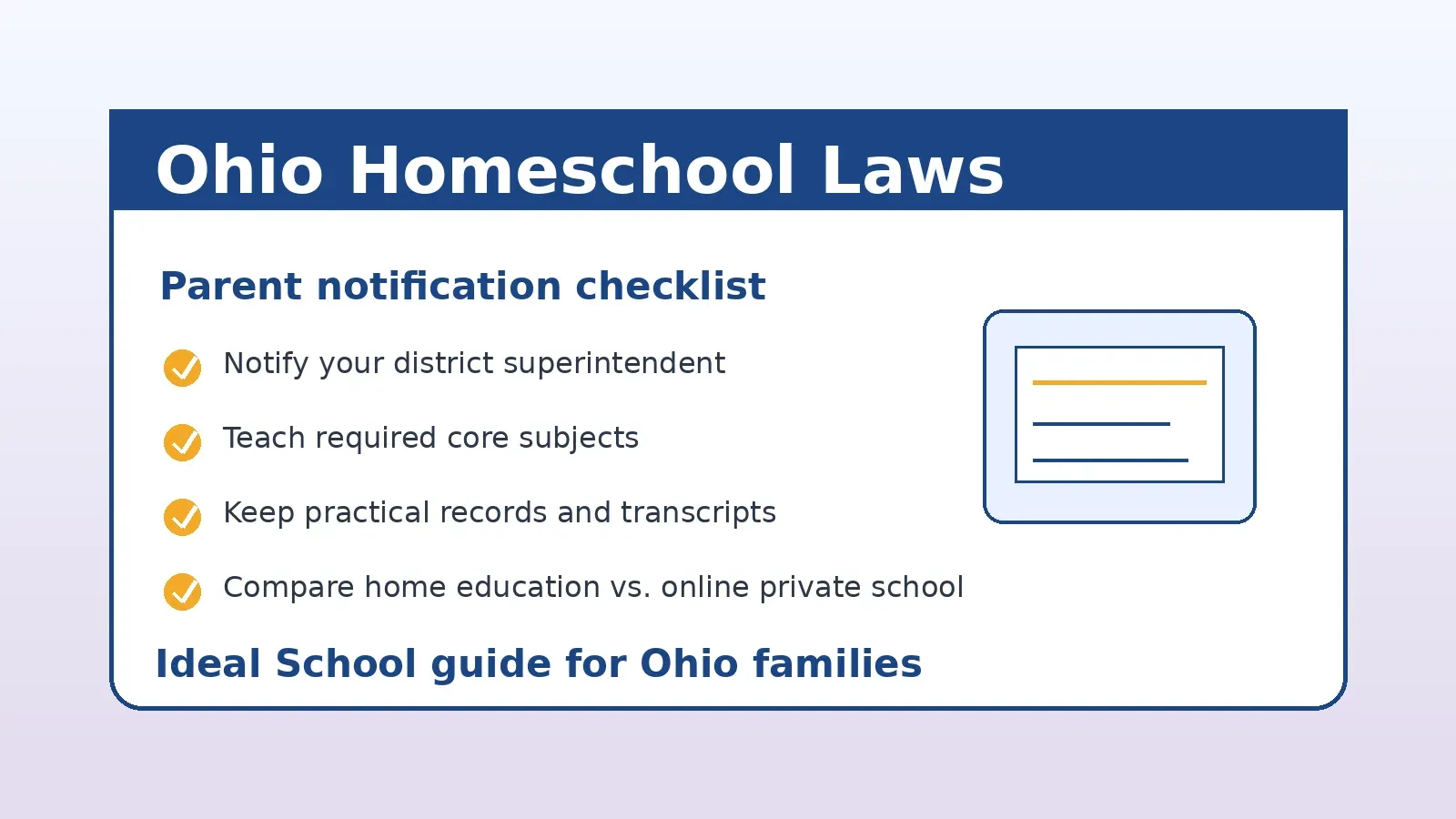
Ohio homeschool laws are simpler than many parents expect, but the details matter when you are withdrawing from public school, moving into a new district, choosing curriculum, or comparing home education with an accredited online private school. Under current Ohio law, parents direct the home education program, notify the district superintendent, and assure instruction in required subject areas.
Considering a flexible accredited online school instead of managing every homeschool requirement yourself? Explore Ideal School’s Full Day Program for live bilingual K-12 instruction from home.
This guide explains Ohio homeschool notification rules, required subjects, assessment expectations, EdChoice scholarship limits, record planning, and the key difference between home education and online school. It is written for parents who want a practical overview before they make a school decision. It is not legal advice, and Ohio families should confirm current requirements with their district and the Ohio Department of Education and Workforce home schooling page.
Ohio Homeschool Laws at a Glance
Ohio calls homeschooling “home education” in state law. The core statute is Ohio Revised Code Section 3321.042, which defines home education as education directed by a parent for a child between the ages of 6 and 18. A student receiving home education in the required subject areas is exempt from Ohio’s compulsory school attendance law after the parent submits notice to the superintendent of the district of residence.
The current rules are more streamlined than older Ohio homeschool requirements. Parents no longer submit a full curriculum outline or annual assessment information as part of the standard notification process. Instead, the notice must include basic family information and an assurance that instruction will cover the required subjects.
| Requirement | Current Ohio rule |
|---|---|
| Who directs the education? | The parent directs the home education program. |
| Who receives notice? | The superintendent of the student’s school district of residence. |
| When is notice due? | Within five calendar days of starting home education, moving districts, or withdrawing from school, and by August 30 each year after that. |
| What subjects are required? | English language arts, mathematics, science, history, government, and social studies. |
| Is annual assessment required? | Current state notification rules do not require parents to submit annual assessment information. |
| Does EdChoice fund home education? | No. Ohio states that EdChoice does not fund home education or partial enrollment for home educated students. |
Who Must Follow Ohio Home Education Rules?
Ohio’s home education statute applies when a parent directs the education of a child between ages 6 and 18 outside full-time enrollment in a public or chartered nonpublic school. If your student is already enrolled full time in a public school, chartered nonpublic school, internet based community school, or district operated online school, that is not the same legal category as parent-directed home education.
This distinction matters because families often use the phrase “online homeschool” for very different arrangements. In Ohio, a parent-created home education program, an Ohio e-school, a district virtual program, and an out-of-state online private school can have different reporting responsibilities. The Ohio Department of Education and Workforce says that if a student is enrolled in an out-of-state online school, parents should notify the district of residence that the student will attend an out-of-state school, rather than filing an intent to home educate.
If your goal is complete parent direction, Ohio home education may fit. If your goal is a structured academic program with teachers, records, grade placement, and school accountability, compare home education with an accredited online private school such as Ideal School’s Cognia-accredited program.
How to Notify Your Superintendent in Ohio
The first practical step is notification. Ohio law requires the parent or guardian to transmit notice to the superintendent of the student’s district of residence. The exemption is effective when the superintendent receives the notice, and the superintendent must provide written acknowledgment within 14 calendar days.
What to include in the notice
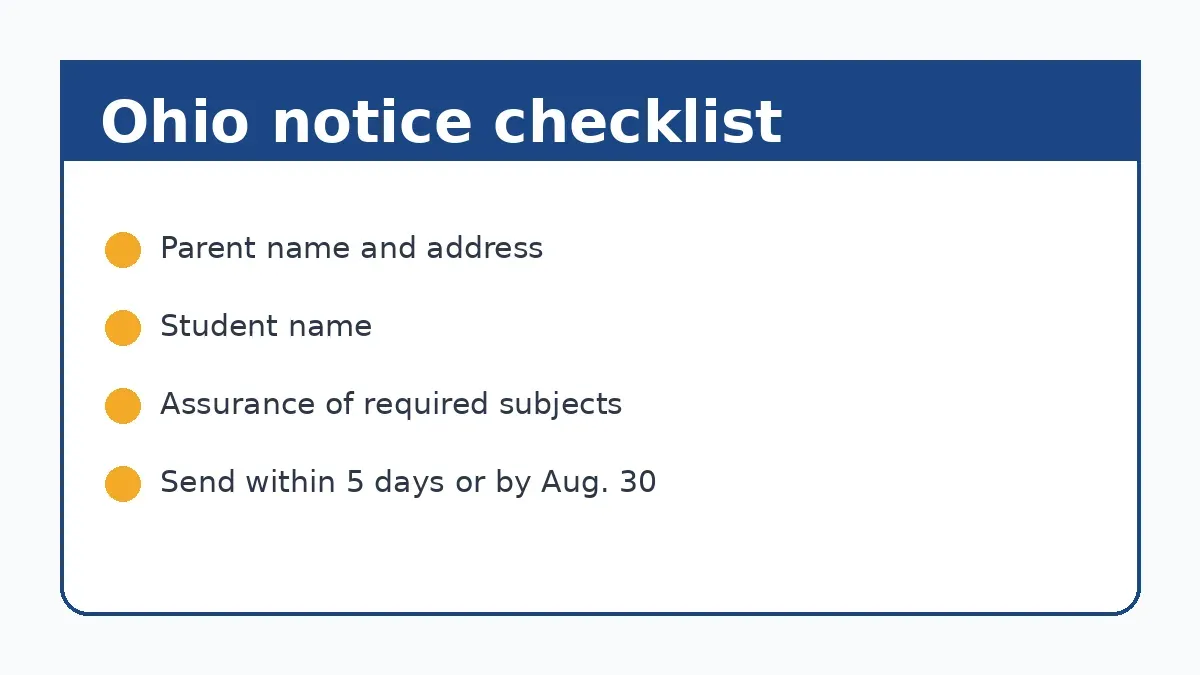
Under ORC 3321.042, the notice should provide:
- The parent’s name and address
- The student’s name
- An assurance that the student will receive education in the required subject areas
Ohio provides a recommended notification form, but parents should check the current state page and their district’s process before sending documents. Keep a copy of everything you submit and the written acknowledgment you receive.
When to send the notice
Ohio gives three common deadlines. Send notice within five calendar days after you start home education, within five calendar days after moving into a new school district, or within five calendar days after withdrawing from a public or nonpublic school. After the first year, send annual notice by August 30.
If you are moving from public school to online private school rather than parent-directed home education, review the transfer process carefully. Ideal School’s guide on how to transfer from public school to online school can help parents think through records, timing, and communication.
Required Subjects for Ohio Homeschooling
Ohio requires home education in six subject areas: English language arts, mathematics, science, history, government, and social studies. The law does not require parents to copy the public school curriculum, use a specific textbook, or follow a district pacing guide. Parents choose the curriculum and educational materials.
That freedom is valuable, but it also makes planning important. A strong Ohio homeschool plan should include a written scope for each required subject, a calendar or weekly rhythm, examples of completed work, and a way to document progress. Even when the state does not require a formal curriculum submission, good records protect continuity if your student later returns to public school, applies to a private school, or prepares for college admissions.
Parents who want more structure can combine home education with outside instruction. Ideal School offers supplemental homeschool classes for families who want professional support in specific subjects while keeping a flexible home education plan.
Does Ohio Require Annual Testing or Assessment?
Current Ohio homeschool laws do not require parents to submit annual academic assessment information as part of the standard home education notification. This is a major change from older Ohio homeschool discussions, so parents should be careful when reading outdated guides.
Before House Bill 33 changed the law in 2023, Ohio homeschool families commonly discussed annual assessment options such as standardized tests or portfolio reviews. Under the current statute and state guidance, the parent notification process is limited to the required notice and assurance. However, Ohio law still says that if there is evidence a home educated student is not receiving education in the required subject areas, the student may be subject to attendance enforcement under ORC 3321.19.
In practical terms, even when annual assessment submission is not required, families should still track learning. Consider keeping samples of writing, math work, reading lists, science projects, history assignments, attendance notes, and any third-party course records. This documentation can help with grade placement, transcripts, and confidence that the home education plan is working.
Ohio Home Education vs. Online School
Many parents search Ohio homeschool laws because they want learning from home, not necessarily parent-managed schooling. The legal route you choose affects responsibility, records, daily instruction, and scholarship options.
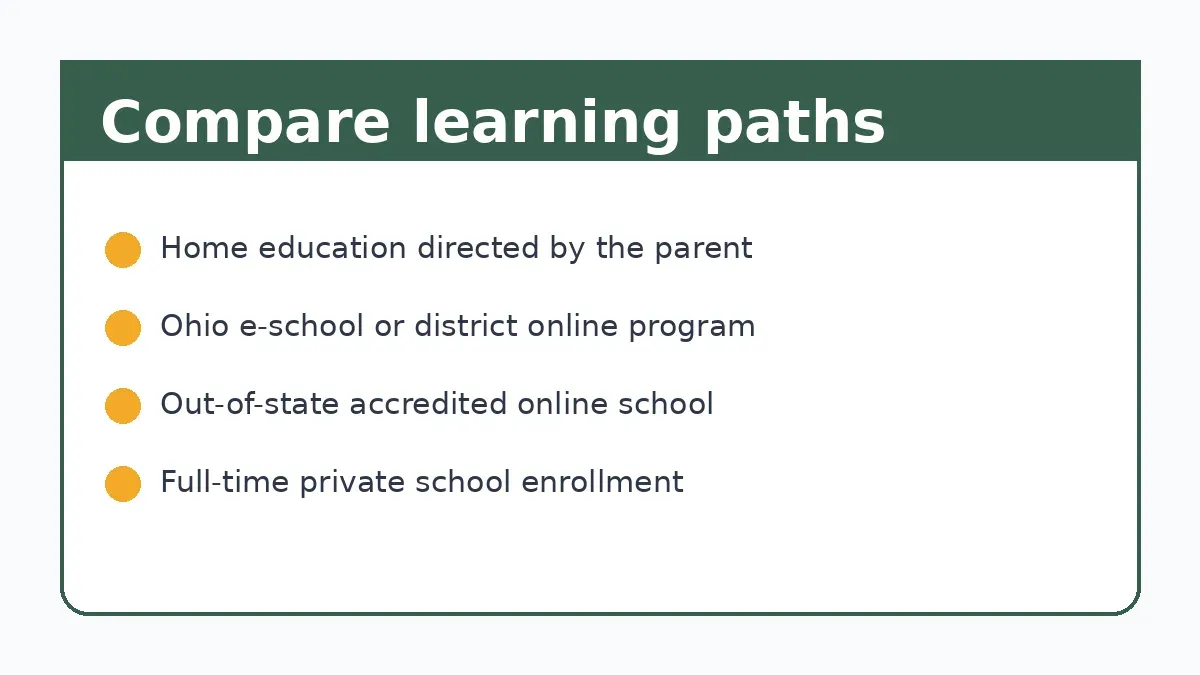
| Option | Who manages instruction? | Best fit |
|---|---|---|
| Ohio home education | Parent directs curriculum and instruction. | Families that want maximum control and can manage records. |
| Ohio e-school or district online program | Ohio public school structure manages instruction. | Families wanting public online education through an Ohio system. |
| Out-of-state online private school | The private school provides instruction, records, and academic program. | Families wanting remote private school from home. |
| Supplemental online classes | Parent manages the homeschool program, with outside support in selected subjects. | Families needing teacher support without switching every subject. |
If you want home-based learning with live teachers, small classes, bilingual instruction, and school-managed academics, learn how live online classes work at Ideal School.
How EdChoice Scholarships Affect Ohio Homeschool Decisions
Ohio’s EdChoice Scholarship Program is important for many families comparing school options. The program helps eligible students attend participating private schools. However, the Ohio Department of Education and Workforce states that EdChoice Scholarships do not provide funding for home education or partial enrollment in a chartered nonpublic school for home educated students.
That means a home education family should not assume EdChoice will pay for parent-directed homeschooling materials or individual classes. The state says home educated students who stop home education and enroll full time in a chartered nonpublic school may be eligible to participate in EdChoice if they meet program rules.
Ideal School’s tuition page explains that the school participates in several state education funding programs, and families can review current pricing and funding information on the Ideal School tuition page. Ohio families should confirm EdChoice eligibility directly with the state and any school they are considering, because scholarship rules can change and participation details depend on the program.
Records Ohio Homeschool Parents Should Keep
Even with a simplified notification process, records still matter. They help parents evaluate progress, support transitions, and build a transcript if the student continues home education through high school.
A practical record system may include:
- Copies of annual notices and superintendent acknowledgments
- A list of curriculum, textbooks, online courses, and instructional resources
- Samples of completed work in each required subject
- Reading lists and major projects
- Attendance or learning activity logs
- Assessments chosen by the parent, even when not submitted to the state
- High school course descriptions, credits, and grades
High school records deserve special attention. Parents who homeschool through grades 9-12 often need to create transcripts, course descriptions, and graduation documentation. Families who prefer a school-issued diploma pathway may want to compare home education with an accredited online high school. Ideal School offers an American High School Diploma Program for students seeking a structured online route.
Can Ohio Homeschool Students Return to Public School?
Yes. Ohio law says that a student enrolling in public school after any period of home education must be placed in the appropriate grade level, without discrimination or prejudice, based on the policies of the district of residence. Districts may review records, credits, assessments, or placement needs according to local policy.
This is another reason to keep organized records. A parent may not need to submit assessments each year, but the family may later need documentation to support grade placement, course credit, or graduation planning. If you are unsure whether homeschooling will be temporary or long term, build records from the beginning.
Common Mistakes Ohio Parents Should Avoid
Most problems come from confusing home education with other learning options, missing notice timing, or relying on outdated rules. These are the mistakes to avoid:
- Assuming online school always equals homeschooling. Ohio separates parent-directed home education from online public schools and out-of-state online school enrollment.
- Waiting too long to notify the superintendent. Notice is due within five calendar days in several common situations and by August 30 each year after that.
- Using outdated assessment advice. Older guides may mention annual assessment submission. Current Ohio notification rules no longer require parents to submit assessment information.
- Ignoring required subjects. Ohio home education must include English language arts, mathematics, science, history, government, and social studies.
- Assuming EdChoice pays for homeschooling. The state says EdChoice does not fund home education or partial enrollment for home educated students.
- Failing to keep records. Records support transitions, transcripts, and long-term planning.
When an Accredited Online School May Be a Better Fit
Homeschooling gives parents control, but it also places curriculum decisions, instruction, documentation, and progress monitoring on the family. For some parents, the real goal is home-based learning with more flexibility than a traditional campus, not necessarily doing every part alone.
An accredited online private school may be a better fit if you want:
- Live teacher-led classes from home
- A complete K-12 curriculum
- School-managed academic records
- Small class sizes and structured schedules
- Bilingual instruction in English and Spanish
- Accreditation and a clearer diploma pathway
Ideal School is a Cognia-accredited online bilingual K-12 private school founded in 2018. Its full-day program covers English language arts, Spanish language arts, mathematics, science, and social studies through live virtual classes. The school also offers supplemental classes for homeschool families, tutoring, a language institute, and an American High School Diploma Program.
To compare Ohio home education with a structured online private school option, contact Ideal School and ask which program fits your family’s goals.
FAQ About Ohio Homeschool Laws
Is homeschooling legal in Ohio?
Yes. Ohio law allows parent-directed home education for students between ages 6 and 18 when parents notify the superintendent and provide education in the required subject areas.
Do Ohio parents need approval before homeschooling?
The parent must notify the district superintendent. The exemption is effective when the superintendent receives the notice, and the superintendent must provide written acknowledgment within 14 calendar days.
What subjects are required for Ohio homeschooling?
Ohio requires instruction in English language arts, mathematics, science, history, government, and social studies.
Does Ohio require homeschool testing every year?
Current Ohio home education notification rules do not require parents to submit annual assessment information. Families should still keep records and may choose assessments for their own planning.
Can Ohio homeschool families use EdChoice?
Ohio states that EdChoice Scholarships do not fund home education or partial enrollment for home educated students. A student who stops home education and enrolls full time in a participating chartered nonpublic school may be eligible if program rules are met.
Is an online private school the same as homeschooling in Ohio?
Not always. Ohio distinguishes parent-directed home education from online schools. If a student attends an out-of-state online school, state guidance says parents should notify the district of residence that the student will attend an out-of-state school.
Final Takeaway
Ohio homeschool laws give parents significant flexibility, but they still require timely notification, instruction in required subjects, and careful decision-making about records, online school options, and funding. The most important first step is to decide whether you want parent-directed home education or a structured online school experience from home.
If you want full control, Ohio home education may be the right path. If you want home-based learning with accredited instruction, live teachers, bilingual education, and school-managed records, Ideal School can help you compare options before you make the transition.