




An online school family learning environment is the home setup that lets a student join class, find materials, and ask for help without a morning scramble. The room can be a kitchen table or a corner of a shared space. What matters is a repeatable place, a short supply list, a known class time, and a reliable way to hear from the school. Families often compare programs before they examine the week they will actually live at home. A short written plan makes the first live week easier to judge fairly.
This guide stays on the home side of enrollment, and it does not rank schools or require a furniture list. It does not promise that a setup will raise grades, and it covers where the student sits and what stays within reach. It also explains how live and self-paced work share the week, and how parents stay informed. If you are still comparing school models, start with the K-12 online schooling family guide, then return here to plan the week.
What an online school family learning environment includes
Treat the environment as four parts that must work on the same morning, because one failure makes the other three harder to use.
The place is one class spot with enough light for the screen and enough quiet to hear the teacher. Materials are the device, headphones, charger, notebook, and login, while time means one block for live class and another for independent work. Communication means a named adult reads school messages, and the student knows when to ask a question.
Ideal School is a K-12 online private school, founded in Seattle in 2018, with live bilingual classes taught in English and Spanish. Students join teachers and classmates in real time, and study-at-your-own-pace classes run from 4th through 12th grade. Live classes are available from kindergarten through 12th grade, and that split matters at home. A kindergartner needs an adult nearby for a live morning, while an older self-paced student needs a Monday start and a Friday finish.
The school says it works hand in hand with families through a daily message board, portals, monthly newsletters, conferences every other month, and a monthly town hall. Those are school channels, and the home plan covers what happens between them. Decide who reads the board, where the notebook lives, and what happens after class.
A separate classroom is not required, because a shared table is enough when everyone else knows that hour is reserved for class. The practical goal is fewer decisions at 8 a.m., rather than a catalog photo of a styled desk.
Set the place before the first live class
Walk through the room during class hour, because light, a nearby television, and a snack break all change what the student can hear.
Check four things in that room, and write each answer down before the first login.
For the seat and screen, show the student’s face rather than a bright window, and use a chair that lets both feet rest steadily. For sound, headphones cut kitchen noise and keep the house private, so test them on a short call before day one. For interruptions, tell the home which hour is live class, and use a closed door or a spoken rule when no door is available. For a backup, name a second seat if the usual corner is taken, and give it the charger and the same login.
The full-day program teaches English language arts, Spanish language arts, math, science, and social studies in small live classes with students from other countries. A student in that day is on camera with classmates, so the place has to work for more than one subject. Moving the laptop at every class change costs the first minutes of instruction.
For a younger student, stay close enough to help with mute, the camera, and the link, then step back once class has started. A middle or high school student can have the adult in another room, as long as someone knows the start time. The student should be able to point to the class seat without hesitating.
Keep study materials in one reachable set
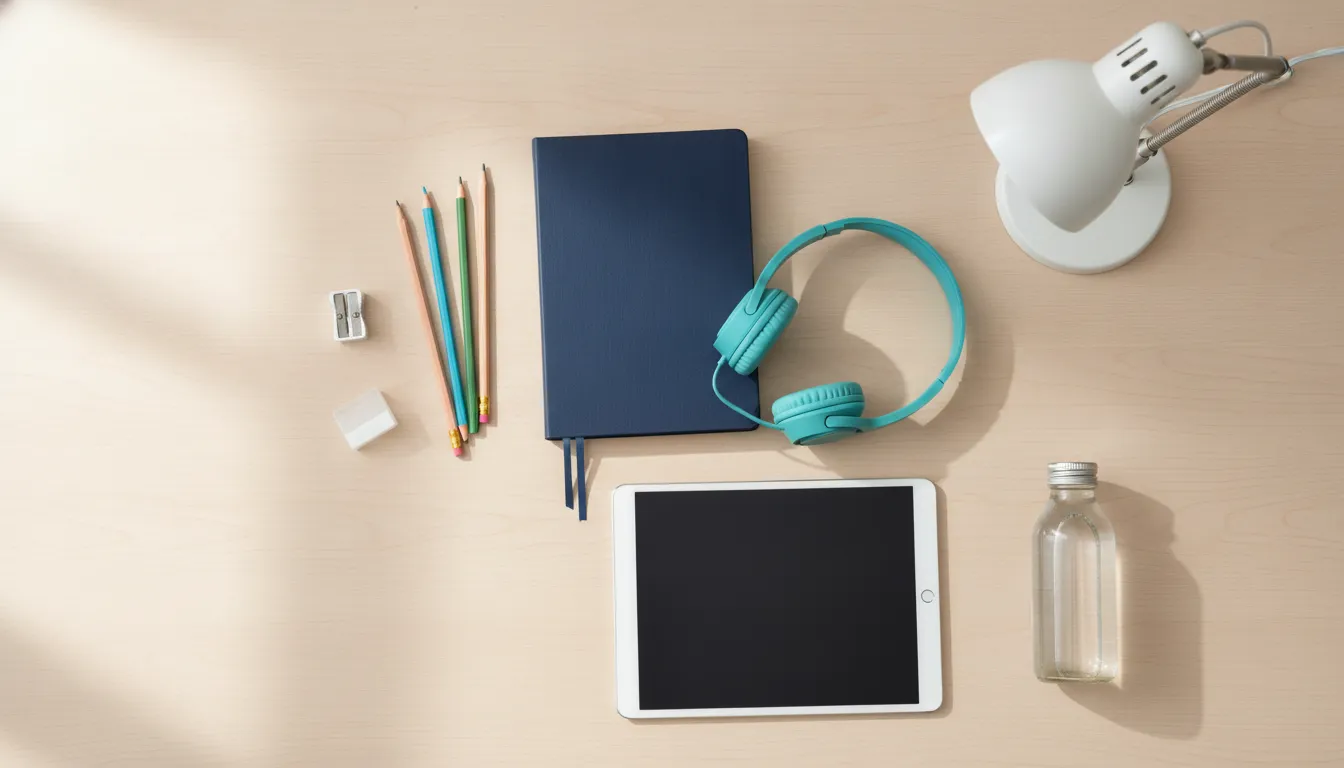
Materials fail when the family owns them but cannot find them at class time. Build one supply set the night before and leave it at the class spot.
Include a charged device that opens the class link, and keep the charger in the same bag or drawer. Add headphones with a microphone, plus a spare pair if you have one. Keep one notebook and a pen for the whole week instead of starting a new stack each morning. Write the login where a parent can find it, rather than relying on a saved password only the student knows. Set out water so a drink run does not interrupt a live explanation.
Self-paced classes send a study guide and activities each Monday, with Friday due dates and corrections the following Friday. Families also receive a monthly follow-up map, which helps only if Monday’s guide has a home. Pick a digital or paper folder and put the new guide there before Tuesday.
Live and self-paced students at Ideal School take exams on the same digital platform. On a test day, close extra tabs and plug in the charger before the exam opens. The platform belongs to the school, while a clear desk is the family’s job.
Full-day families also get a monthly art class and a weekly social group. Those are extra live moments rather than extra shopping lists. Add them to the same weekly note as the core classes, so art supplies and the social-group link are not a Friday surprise.
If the student takes one supplemental class instead of a full day, keep the same rule at a smaller scale. One subject still needs one device, one notebook, and one known hour, and a thinner course load does not lower the chance of a missing login.
Match the week to live class and independent work
A useful week has two kinds of time, and they should not compete for the same hour. Live time is when the teacher and classmates are present, and independent time is for the guide, notes, or a tutor reply.
Write the week in four lines so live class and independent work do not share the same hour.
For live blocks, list each class start, including the social group or the weekly live session in self-paced study. For work blocks, protect Monday time to read the guide and time before Friday to submit the work. For the adult check, spend ten minutes on Sunday confirming the device, the folder, and the next day’s first class. For the question window, set a daily time for stuck work instead of saving every problem for Friday.
Self-paced students can email a tutor and should receive a reply within 24 hours. They also have a one-hour live session each week, so send the email before that window closes. If a task is missed, it carries into the next week, so Friday is a real stop rather than a suggestion.
A full live day needs the opposite emphasis, because the class hour is fixed and the home plan protects the gaps between subjects. A five-minute stretch and a charged device beat a long break that runs into the next login.
How a full day is built is covered in the guide to full-time online school for K-12 students. Use that page for the school-day shape, and use this one to decide who is home and where the student sits. Also mark which hour stays free of errands.
Students who want a personal study plan can read how to choose an online school study planner. A planner tracks the student’s tasks, but it does not replace the class-time rule or the Monday folder.
Use a simple online school family learning environment checklist
Run this once before the first week, then repeat it on Sunday for about ten minutes. Mark a row only when you have seen the item, because a plan to do it later does not count.
| Check | What good looks like | Fix if it fails |
|---|---|---|
| Place. | The student can sit, see the screen, and be heard. | Move the seat or name the backup spot. |
| Sound. | Headphones work on a test call. | Swap the pair before class morning. |
| Power. | The device and charger are at the class spot. | Charge overnight and leave the cord there. |
| Materials. | The notebook, pen, and login are in one place. | Rebuild the set the night before. |
| Monday guide. | The new study guide is in the folder. | Download it before Tuesday’s work block. |
| Live times. | Class hours are written down. | Add the missing hour to the family note. |
| Friday stop. | Independent work is submitted before the due time. | Start the unfinished piece on Thursday. |
| School messages. | One adult read the board or portal this week. | Set a recurring ten-minute read. |
The list stays short on purpose, since a longer checklist becomes another task nobody opens. If two rows fail in the same week, fix those two first before you add a new task.
Keep communication short and two-way
The Institute of Education Sciences describes family engagement as ongoing two-way communication about learning, not a stack of one-way notices. A 2021 IES post on distance-learning classrooms asks for open channels and for time set aside for questions. The post cites decades of research linking that contact with how students perform. For the home plan, pick the channel you will actually use and open it on a schedule.
At Ideal School, the channels already exist. Choose one primary place to look, usually the parent portal or daily message board, and keep the newsletter as a backup. Conferences and the monthly town hall are for longer questions, not for discovering that Thursday’s link was missing.
Agree on three short reports for when something goes wrong, and name the problem before the class hour ends.
For login trouble, the student should speak up in the first five minutes, because waiting until the hour ends wastes the class. For unclear directions, write the question down and send it during that day’s question window. For finished Friday work, confirm the file was submitted, because a file saved only on the device is not turned in.
Parents do not need to attend every lesson, but they need to hear when a student is stuck and give the teacher a way to reach them. The online school community guide covers how families judge student and teacher connection. This section only asks who reads the message and how quickly the student asks for help.

Adjust the plan by grade without rebuilding the house
The place and the materials can stay steady from grade to grade. What changes is the help an adult gives at the start of class and at the Friday stop.
Kindergarten through 3rd grade. These students are in live classes, because the self-paced option begins in 4th grade. An adult should start class in the room and handle the link, the mute button, and a bathroom break. Keep the class spot close to that adult so help does not require a search through the house. The monthly art class and weekly social group can use the same device and the same seat.
4th through 6th grade. Students may take the live full day or self-paced study, and a self-paced week starts by reading Monday’s guide together once. Then let the student work, and check the Friday submission before dinner. A missed task rolls into the next week.
7th through 12th grade. The student can own the folder, the question window, and the Friday stop, while the adult still reads messages and joins conferences. A high school live day still needs a quiet hour, because independence is about who tracks the work. It is not permission to hold class in a noisy room.
Families leaving a campus school can read the transition to online private school guide for the change in school structure. The home change is smaller: keep the same device, the same seat, and a written week. Families comparing a private online school with teaching every subject at home can use the private online school and homeschooling comparison. Ideal School is a K-12 school with teachers for students who study from home, and parents are not the course teachers.
Review the first month and change one thing
After four weeks, look at friction in the routine instead of judging whether the room looks finished. Ask three questions, and change only the answer that caused the most missed time.
- Which morning started late? Was the cause the link, the charger, or the seat?
- Which assignment slipped past Friday? Was the guide missing, or was the work block too short?
- Which school message sat unread? Who was supposed to open it?
Change one answer: if the charger was the problem, charge it overnight instead of buying a new desk. If Friday slipped, move the work block to Thursday, and if messages sat unread, read them on a day you already check email.
The 2026-2027 school year at Ideal School started on September 28, 2026, and enrollment stays open through the year. A family joining midyear can still use the same four-week review, because the goal is not to rebuild a campus routine. The test is whether this house can support the week the family chose.
When the place, the materials, and the message habit hold for a month, an ordinary Tuesday is the standard worth keeping. A quieter corner and a found charger will help the week more than a room redesign.
Ask admissions about the online school program
Frequently asked questions
Do we need a separate room for online school?
No separate room is required when a kitchen table or a corner lets the student attend every class and be heard. The rest of the home needs to know that hour is class, and the family should name a backup seat if the usual spot is taken.
What should be ready before a live class?
Have a charged device, headphones, the charger, one notebook, and the login ready, and test the headphones before the first day. Leave that set at the class spot the night before.
How is a self-paced week different at home?
At Ideal School, self-paced classes run from 4th through 12th grade, a study guide arrives on Monday, and work is due Friday. A missed task carries into the next week, and tutors answer email within 24 hours. Students also have a one-hour live session each week, so the home plan needs a Monday folder and a Friday stop.
How involved should parents be?
Younger students need an adult when live class starts, while older students can track their own folder and Friday work. In every grade, one adult should read school messages on a set day through the message board, portals, newsletters, conferences, or town halls.
Where can we ask about class format before we enroll?
Use the contact page to ask about live classes, self-paced study, or one supplemental class, and use the enrollment form when you are ready to apply. The tuition page lists program costs separately from this setup guide.

Written by
Eric C. Franzen
Eric C. Franzen is co-founder and owner of Ideal School, with 20+ years of experience as an educational leader and entrepreneur. He holds a BA in Education from the University of Washington and an MA in Educational Administration from Seattle Pacific University.
View LinkedIn Profile →