



The first year of online school is less about making a perfect choice on paper and more about finding a rhythm your child can sustain at home. Families considering a dual-language program should look closely at language readiness, comfort with teacher-led screen time, independence, and the support available between classes.
Review enrollment and ask about first-year fit
An online dual language school first year works best when the learner’s goals match the format. The family also needs a consistent place, schedule, and routine for schoolwork. Live classes are available from Kinder through 12th grade, while asynchronous classes are available from 4th through 12th grade, so grade level matters when you compare options.
Before comparing schools, picture an ordinary week. Note when your child will join lessons, how an adult will help with transitions, and how both languages fit the day. That practical picture makes it easier to assess whether the learner and the household are ready for the first year.
Who an online dual language school first year fits.
A first year can fit a learner who is ready to hear and use English and Spanish during the school day. Confidence in one language can still be developing. Prior Spanish is not required for every learner. What matters is a willingness to participate in both languages as the student works through regular school subjects with bilingual teachers.
A child building Spanish from the early grades.
For a child beginning Spanish in the early grades, the first year may involve listening closely before speaking with ease. Live classes give the student repeated opportunities to hear Spanish in context and gradually use it during lessons. At Ideal School, live classes are available from Kinder through 12th grade, with core live subjects including English language arts, Spanish language arts, math, science, and social studies. A family considering the full-day live program should expect both languages to be part of the learning routine, not an occasional add-on.
A heritage Spanish speaker developing academic English.
A heritage Spanish speaker may understand everyday Spanish well while still needing time to build English academic language. School discussion, reading, writing, and subject vocabulary can feel different from casual conversation. The first year should leave room for uneven confidence: a student may contribute readily in one language and pause more often in the other. That pattern is a normal part of using both languages for school subjects, not evidence that the student cannot learn in the setting.
A family moving between countries.
Families who move between countries may value a school day that keeps both languages active while the student adjusts to changing surroundings. Ideal School’s live classes bring together bilingual teachers and students from more than 20 countries. That setting can make regular cross-border transitions feel less separate from school life, while still requiring the student to engage with the same core subjects in both languages. Reviewing the school’s live bilingual class routines can help a family picture the day before deciding whether it matches the learner’s needs.
In any of these situations, early silence, fatigue, or uneven confidence can be expected signs of adjustment. The first year asks for steady practice, patience, and participation across both languages; it does not require instant comfort in every lesson.
What the first-year home routine actually changes.
The first year in an online dual language school often changes the shape of an ordinary weekday more than the furniture in your home. A child needs a predictable place to join class, materials that are easy to reach, and a routine that makes the next step clear. These changes do not require a classroom replica. They require a home setup that supports attention and steady participation.

Build a small, repeatable study setup.
Start with a quiet study spot that your child can use for live classes without frequent interruptions. A comfortable headset can make it easier to hear the teacher and speak when invited, especially when other people are working nearby. Keep the essential materials in the same place so your child is not searching for a notebook or login information at the start of each class. A setup like this can also make elementary online school routines easier to maintain as the year becomes more familiar.
Put the week on paper.
A written weekly plan helps the family see live classes, preparation, assignments, breaks, and activities together. It does not need to be elaborate. A simple planner can show which materials are needed each day and when an adult should check in. For a younger child, an adult may need to help with logging in, finding the right class, reading directions, and returning to the task after a break. That adult is a logistics partner, not the language teacher. The school provides instruction; the adult helps make access and follow-through possible.
Use the published schedule as a planning reference, not a permanent promise. The current full-day page lists Kindergarten live classes from about 7:30 to 1:15. Middle and high school live classes run later, with the day listed from about 7:30 to 2:35. Families should confirm the current timetable before enrolling because schedules can change. The same full-day information currently mentions a monthly art class and a Friday social group as extras; treat those as current program details to verify, not guaranteed outcomes. If you are comparing options, ask Ideal School about the current schedule before building your household plan.
Live classes or asynchronous study in the first year.
Choosing a first-year format for an online dual language school depends on the learner’s grade. The schedule your household can sustain, and how much structure is helpful during the week. Ideal School currently offers live full-day classes from Kindergarten through 12th grade. Asynchronous study is available only from 4th through 12th grade, so it is not offered below 4th grade.
Use this comparison to match the week to the grade.
| Format | Grades currently offered | How the week works | Best first-year fit |
|---|---|---|---|
| Live full-day classes | Kinder through 12th grade | Daily live classes in English and Spanish for core subjects. | Students who can keep a set daytime schedule. |
| Asynchronous study | 4th through 12th grade only | Monday study guide and Friday assignments, weekly one-hour live support, email help answered within 24 hours, and exams on the same digital platform. | Students in grade 4 or above who need a flexible week. |
Monthly tuition is published by grade band, and the monthly figure does not include separate annual fees. Live full-day pricing is listed for Kindergarten, grades 1 to 3, grades 4 to 6, and grades 7 to 12. Asynchronous full-day pricing is listed only for grades 4 to 6 and grades 7 to 12. Read the current tuition and annual fees page before you compare a first-year budget.
Families considering the flexible format can review the details of asynchronous classes for grades 4-12 before comparing the weekly rhythm with their needs. For context on school-level quality frameworks, Cognia publishes performance standards for K-12 institutions. Accreditation applies to the school, not to a curriculum.
What to settle before the first day.
-
Confirm the grade and format. Check the student’s grade and ask whether the preferred format is available for it. Ideal School states that live classes are available from Kinder through 12th grade, while asynchronous classes are available from 4th through 12th grade. This is an important first check when comparing an online dual language school first year option.
-
Gather the requested records. Set aside the prior report card and birth certificate before completing the enrollment form and required records. Having these documents ready can make it easier to answer the form accurately without turning the first day into an administrative catch-up.
-
Plan login support. Decide which adult will be available to help a younger student sign in, find the right class, and understand the day’s first instruction. The goal is not to manage every task, but to make the opening routine predictable while the student builds independence.
-
Ask how language placement works. Before choosing classes, ask how the school considers the student’s Spanish and English experience for that grade. Families can review the online bilingual enrollment steps and use any remaining questions to clarify placement directly with the school.
-
Choose the right enrollment scope. Decide whether the student needs the full set of subjects or one supplemental subject class. A supplemental subject class is not full-school enrollment, so confirm which option matches the family’s education plan. If school accreditation is part of the decision, Ideal School states that it is accredited by Cognia; its history and accreditation information provides additional context.
Early signals that the first year is working.
The first month may be quieter than a parent expects. Progress in two languages is often uneven, and a student may need time to understand the classroom rhythm before showing much confidence. Look for small changes in participation and independence rather than promising test-score gains.
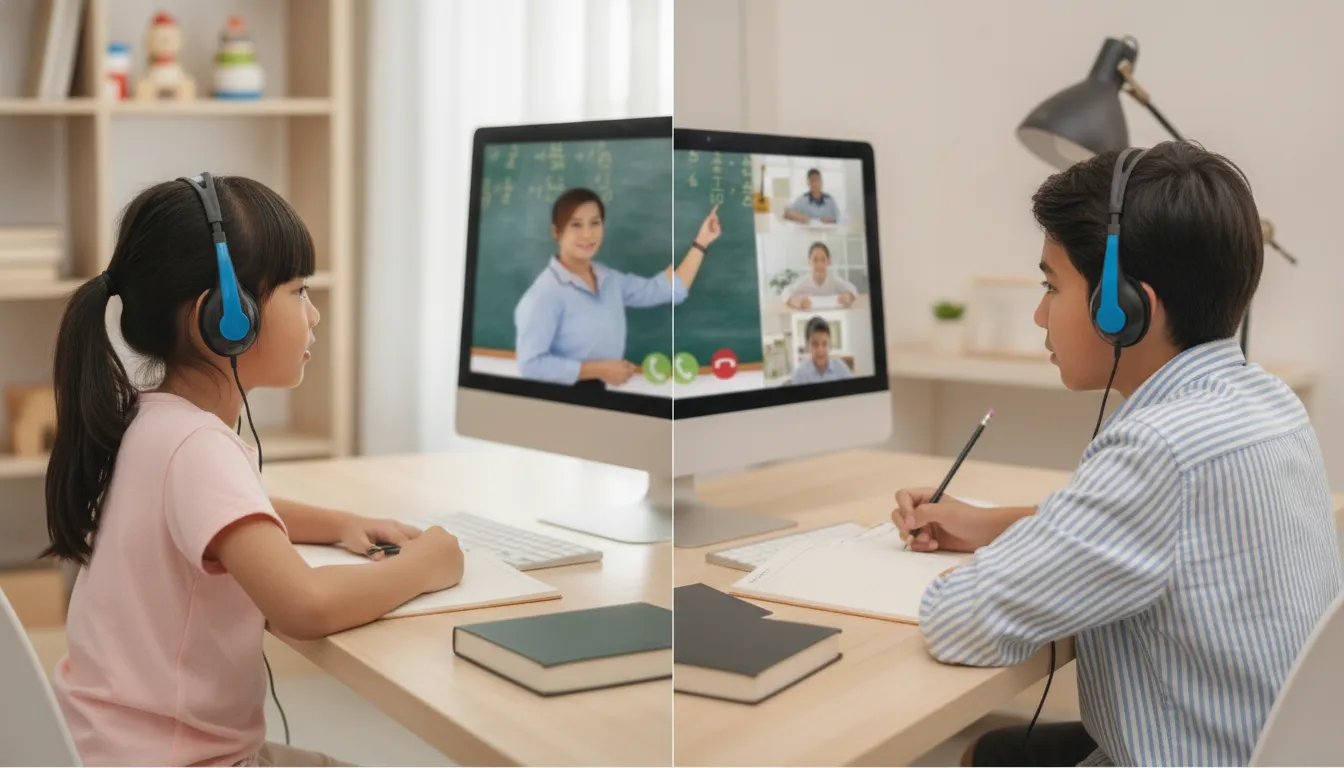
Useful early signals include:
- More independent access: The student can log in alone, or needs a smaller amount of help with the same steps each week.
- A willingness to try: The student attempts a short answer in the less familiar language, even when the grammar or vocabulary is still developing.
- Awareness of the weekly rhythm: The student knows when classes happen, where to find assignments, and what needs to be finished before the week ends.
- A sense of connection: The student can name at least one classmate or teacher and describe something they did together.
These signs do not need to appear at the same time. A student may manage the login routine while still answering only briefly in the second language. Another may participate readily but need reminders to track assignments. That uneven pattern is normal enough to observe without turning it into a verdict on the school model.
Some patterns call for a schedule conversation, not an immediate conclusion that online learning is failing. Contact the school if logins are repeatedly missed, work continues to pile up past Friday, or the student stops attempting the second language for several weeks. Before that conversation, note when the difficulty appears, how much support is needed, and whether the issue is tied to a particular class or day. A clearer routine, a check-in, or a manageable adjustment may address the barrier.
For the terminology behind the program, read what dual language immersion means. Families exploring options for older students can also review bilingual high school options.
See the full-day live program before you decide
Frequently Asked Questions.
How can we tell whether online dual language school is a good fit for our child?
Look at your child’s starting language experience, comfort with online participation, and need for adult support during the school day. Also consider your family’s goals for English and Spanish, the learning pace your child can manage, and whether the school’s communication style fits your expectations.
What should our home routine include before the first day?
Set a consistent learning space, a dependable start time, and a plan for meals, breaks, materials, and help with technology. Decide which adult will check schedules and follow up on unfinished work. A simple routine makes it easier to notice when your child needs clarification or encouragement.
Which grades can take live or asynchronous classes?
Ideal School offers live, synchronous classes from Kinder through 12th grade. Asynchronous classes are available from 4th through 12th grade. Confirm the current format, schedule, and enrollment details for your child’s grade before choosing a program. Review the full-day program.
What should we settle with the school before day one?
Ask how instruction is delivered, how families receive schedules and progress updates, what participation is expected, and where to get help with questions or technical issues. Confirm the program’s grade eligibility and start details in writing, then make sure your child knows the daily routine and how to ask for support.
A first year you can plan.
An online dual language school first year is a fit question, not a ranking. Match the grade to a live or asynchronous week, protect a quiet place and an adult for login. And ask the school how language placement works before the first morning.

Written by
Eric C. Franzen
Eric C. Franzen is co-founder and owner of Ideal School, with 20+ years of experience as an educational leader and entrepreneur. He holds a BA in Education from the University of Washington and an MA in Educational Administration from Seattle Pacific University.
View LinkedIn Profile →