

Choosing an elementary school means balancing academic consistency with the way your family actually lives. You may be comparing a traditional classroom, homeschooling, and a virtual option while asking whether your student will receive enough structure, guidance, and connection each day.
Online elementary school programs give K-5 students a structured education through digital lessons, teacher support, and flexible routines, with some schools also offering live instruction and bilingual learning. Research on blended and online education emphasizes the importance of active academic, instructional, and technology support for personalized learning (ERIC).
The right program is more than a collection of lessons on a screen. It should make expectations clear, keep teachers involved, and give parents meaningful visibility into progress. Understanding how virtual elementary education is organized is the first step toward comparing schedules, curriculum, student interaction, and the level of support your family needs.
Schedule a free live demo class to see how online elementary school works for your family
What Are Online Elementary School Programs and How Do They Work?
Online elementary school programs provide a complete or supplemental K-5 education through digital classrooms and learning platforms. Instead of commuting to a school building, students access lessons, instruction, assignments, and teacher support online. The strongest programs combine a planned curriculum with flexibility, so families have a clear academic path without requiring every student to learn at exactly the same pace.
These programs have expanded as families have looked for more personalized learning environments and alternatives to a one-size-fits-all classroom model. Research on blended and online education emphasizes the importance of academic, instructional, and technology support when schools use online learning to personalize education. Read the research on personalized online learning.
Synchronous learning: instruction at a set time
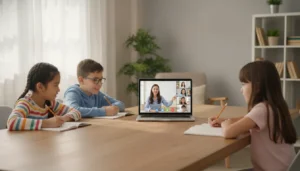
In a synchronous model, students and teachers meet live in a virtual classroom at scheduled times. Students can ask questions, participate in discussions, complete collaborative activities, and receive immediate feedback. Ideal School uses synchronous instruction, with live online classes designed to make teachers active partners in the learning experience. This structure can provide the routine and connection of a traditional classroom while removing the need to attend school in person.
Asynchronous learning: progress on a flexible schedule
Asynchronous programs provide recorded lessons, digital materials, assignments, and other activities that students complete independently or with parent support. Families may value this model when they need more control over the daily schedule. However, parents should confirm how quickly students can receive teacher feedback, how questions are answered, and what keeps learning on track.
How online school differs from traditional homeschooling
Traditional homeschooling usually places curriculum selection, lesson planning, instruction, and progress monitoring primarily with a parent or guardian. An online school program typically supplies the curriculum, certified teachers, assignments, assessments, and school structure. Parents remain important partners, but they do not have to build the entire academic program alone. Some families also combine both approaches by using an online school for core instruction and adding home-based enrichment.
When comparing programs, ask whether the model is live, self-paced, or a combination of both. Then consider class size, teacher access, curriculum coverage, schedule expectations, and how the school communicates student progress.
What Does a K-5 Online Curriculum Include?
A well-designed elementary curriculum covers the same foundational areas families expect from a traditional school, while giving students consistent instruction, practice, and feedback online. K-5 programs generally serve learners from kindergarten through fifth grade, with lessons organized by grade-level goals and subjects. Online elementary programs commonly serve kindergarten through fifth grade, and engaging video lessons can help introduce concepts in a clear, accessible way.
Core subjects for elementary learners
The core curriculum typically includes English language arts, mathematics, science, and social studies. English language arts develops reading comprehension, writing, vocabulary, grammar, and communication. Mathematics builds fluency with numbers before moving into problem-solving, geometry, measurement, and other grade-level concepts. Science connects observation and inquiry with topics such as life science, physical science, and the world around us. Social studies helps students understand communities, history, geography, civics, and their place in a wider society.
At Ideal School, the full-day program adds Spanish as a core subject alongside English, math, science, and social studies. This five-subject structure gives families a complete academic program rather than a collection of disconnected supplemental lessons. Explore Ideal School’s Full Day Program to see how the subjects fit together in a school-day experience.
What makes dual-language immersion different?
Some online schools deliver the full curriculum in English only. Ideal School offers a two-way dual-language immersion model, with instruction divided between English and Spanish using a 50/50 language allocation. English-dominant and Spanish-speaking students learn together, so both languages function as tools for understanding content and communicating with classmates. The goal is not simply to add a language class to the schedule. Students develop academic knowledge while using both languages in meaningful classroom contexts.
For families preserving Spanish at home, seeking a bilingual pathway, or looking for a more linguistically inclusive school environment, this model can be a meaningful differentiator. Read the dual language immersion guide for a closer look at how the approach works online. When comparing online elementary school programs, parents should ask whether Spanish is an isolated elective or part of the academic learning model itself.
A Day in the Life: What to Expect from an Online Elementary Schedule
A well-designed elementary schedule gives students the predictability of a school day without requiring every family to follow the same brick-and-mortar routine. At Ideal School, kindergarten instruction typically runs from 7:30 a.m. to 1:15 p.m. The day includes several subject areas, live class time, and purposeful breaks rather than one uninterrupted stretch in front of a screen.
What the school day can look like
The morning may begin with core instruction, followed by lessons in subjects such as English, Spanish, mathematics, science, or social studies. Breaks help younger students reset, move, get a drink, and return ready to participate. The exact sequence can vary by grade, but the rhythm remains clear: meet with the teacher. Practice a skill, transition, and receive feedback before moving to the next lesson.
That structure differs from a fully self-paced course. Self-paced options can be useful when a family needs maximum scheduling flexibility, but they also place more responsibility on a parent or student to create momentum. Live instruction provides a scheduled point of connection, immediate opportunities to ask questions, and a classroom community that encourages students to stay engaged. Year-round enrollment and flexible start dates are also common features of online elementary education programs, giving families more choice about when to begin their online elementary program.
Small classes and active participation
Small class sizes make it easier for teachers to notice confusion, invite each student into the discussion, and adjust support during a lesson. In a synchronous classroom, engagement is not limited to watching a recording. Students can respond, practice, collaborate, and build familiarity with their classmates and teacher in real time.
A manageable rhythm for parents
Parents are partners without needing to conduct every lesson. The parent portal provides real-time access to student progress, while bi-monthly conferences create a regular opportunity to discuss strengths, questions, and next steps with the school. Between conferences, families can use the portal to stay informed and support routines at home. This combination of live teaching, planned breaks, and transparent progress updates gives the school day structure while keeping parents connected to the learning experience.
How Online Elementary School Programs Address Socialization and Screen Time
Socialization is one of the first concerns many parents raise when they consider an online option. A well-designed program does not ask students to learn in isolation. Live classes create a consistent space for students to see their teachers and peers, ask questions, share ideas, and practice listening and collaboration. Small classes also give students more opportunities to contribute than they might receive in a large classroom.
Group projects and partner activities can make peer interaction purposeful. Students learn to divide responsibilities, explain their thinking, respond respectfully, and complete a shared task. Those skills are social as well as academic. Parents researching a change from a traditional school may also find it useful to review evidence about family experiences. One survey found that parents of students who moved to Stride K12-powered online schools reported positive views of how their students were doing after facing challenges in previous school settings. Read the survey summary from the Education Resources Information Center.
A broader community for meaningful interaction
Online learning can also expand the range of perspectives students encounter. Ideal School serves students from more than 20 countries and uses a two-way English-Spanish dual-language immersion model. That creates opportunities for authentic multicultural interaction, language practice, and curiosity about how other families experience the world. In a traditional classroom, students may interact primarily with peers from one local community. A bilingual online classroom can add a wider social and linguistic dimension while still providing a structured learning environment.
Balancing instruction with offline time
Screen time should be considered by quality and purpose, not only by total minutes. A structured school day can separate live instruction from breaks, movement, reading, hands-on assignments, creative work, and outdoor activities. Teachers and parents can coordinate transitions so students are not expected to remain continuously engaged with a screen. Offline practice also helps students apply concepts away from the device and build independence.
Parents should ask how often classes meet live, where breaks occur, how group work is supervised, and what assignments can be completed offline. They should also ask what academic and instructional support is available. Research on online school choice shows that parents value finding a model that meets their students’ specific academic and instructional needs. That fit is central to evaluating an online program, including its approach to relationships, language, and healthy technology habits.
How to Choose the Right Online Elementary School Program for Your Family
The best choice is the one that fits your student’s learning needs, your family’s schedule, and your expectations for support. Start by checking the fundamentals, then compare how each program delivers the day-to-day experience.
Check accreditation and school oversight
Accreditation is an important quality signal because it shows that an independent organization has reviewed a school’s standards and operations. WASC accreditation is one example used by online elementary providers, including programs serving kindergarten through fifth grade. Ideal School is accredited by Cognia and registered with the Florida Department of Education. Review the school’s Cognia accreditation details and ask how credits, records, and student progress are documented.
Look beyond the platform
A strong program should offer more than recorded lessons. Ask whether students learn with certified teachers, how often they interact with teachers and peers, and whether the curriculum covers English, Spanish, mathematics, science, and social studies. Personalized learning is one reason families evaluate online options, but personalization works best when it is paired with meaningful academic, instructional, and technology support.1 For families seeking bilingual instruction, confirm that language learning is built into the academic model rather than offered as an occasional elective.
Compare structure, support, and total cost
| Program type | Typical cost | Structure | Teacher interaction | Accreditation |
|---|---|---|---|---|
| Full-day accredited private school | Ideal School: $379.99/month, or approximately $5,000-$6,000/year | Scheduled school day with a complete K-5 curriculum | Live instruction, certified bilingual teachers, and ongoing family support | Cognia; verify each school’s status |
| Self-paced online school | Varies by provider | Flexible lessons completed at an individual pace | May be limited or available by appointment | Some providers hold regional accreditation, such as WASC; verify directly |
| Public online school | Often tuition-free for eligible residents | School-calendar structure with online coursework | Teacher support varies by state and provider | Check the state program and issuing school |
| Homeschool supplement | Varies by class or package | Selected subjects or enrichment alongside home education | Usually limited to enrolled classes | Depends on the provider and whether it awards records |
Price should be compared with the support included, not just the monthly number. Traditional private elementary schools can cost roughly $15,000-$30,000 per year, while online tuition may offer a different balance of structure, flexibility, and family involvement. Ideal School also participates in four state voucher programs, though eligibility depends on the program and student’s circumstances. Review the about Ideal School, confirm the details that matter to your family, and use the enrollment page to ask questions before making a decision.
Frequently Asked Questions
How do I verify accreditation for an online elementary school?
Ask which organization accredits the school, confirm the accreditation directly with that organization, and check whether the school serves the grade level your student will enter. Ideal School’s verified accrediting body is Cognia. Also ask how records, course completion, and transfers are handled if your family later changes schools.
How much do online elementary school programs cost?
Tuition varies by school, grade, schedule, and included services. Ideal School’s listed pricing is $379.99 per month, or approximately $5,000 to $6,000 per year, depending on the enrollment arrangement. When comparing programs, ask whether live instruction, materials, tutoring, technology support, and extracurricular opportunities are included rather than comparing tuition alone.
Will my student have opportunities to socialize online?
A well-designed program creates regular interaction through live classes, discussions, group activities, and teacher feedback. Ask how often students work together and whether classes are genuinely interactive or mainly independent screen work. Ideal School uses synchronous virtual classrooms, small class sizes, and multicultural interaction to help students build relationships while learning.
What subjects are included in an online elementary curriculum?
Core instruction commonly includes language arts, mathematics, science, and social studies, with additional language, arts, or enrichment options depending on the school. Ideal School’s full-day program includes English, Spanish, math, science, and social studies, with two-way dual-language immersion for families seeking structured instruction in both English and Spanish.
Can my student start an online elementary program outside a traditional school-year schedule?
Some online schools offer flexible start dates or year-round enrollment, while others follow a fixed academic calendar. Confirm the start date, attendance expectations, daily live-class times, and process for transferring records before enrolling. Ideal School can accommodate rapid enrollment, with students potentially starting within 24 hours to 7 days after the required steps are complete.
Ready to Explore the Right Online Elementary Option?
Choosing an online elementary school program is an important decision for your family. A live class can help you understand the learning environment, ask practical questions, and see whether the program fits your student’s needs. To schedule a free live demo class, visit the enrollment page and take the next step toward finding a clear path forward.

Written by
Eric C. Franzen
Eric C. Franzen is co-founder and owner of Ideal School, with 20+ years of experience as an educational leader and entrepreneur. He holds a BA in Education from the University of Washington and an MA in Educational Administration from Seattle Pacific University.
View LinkedIn Profile →