

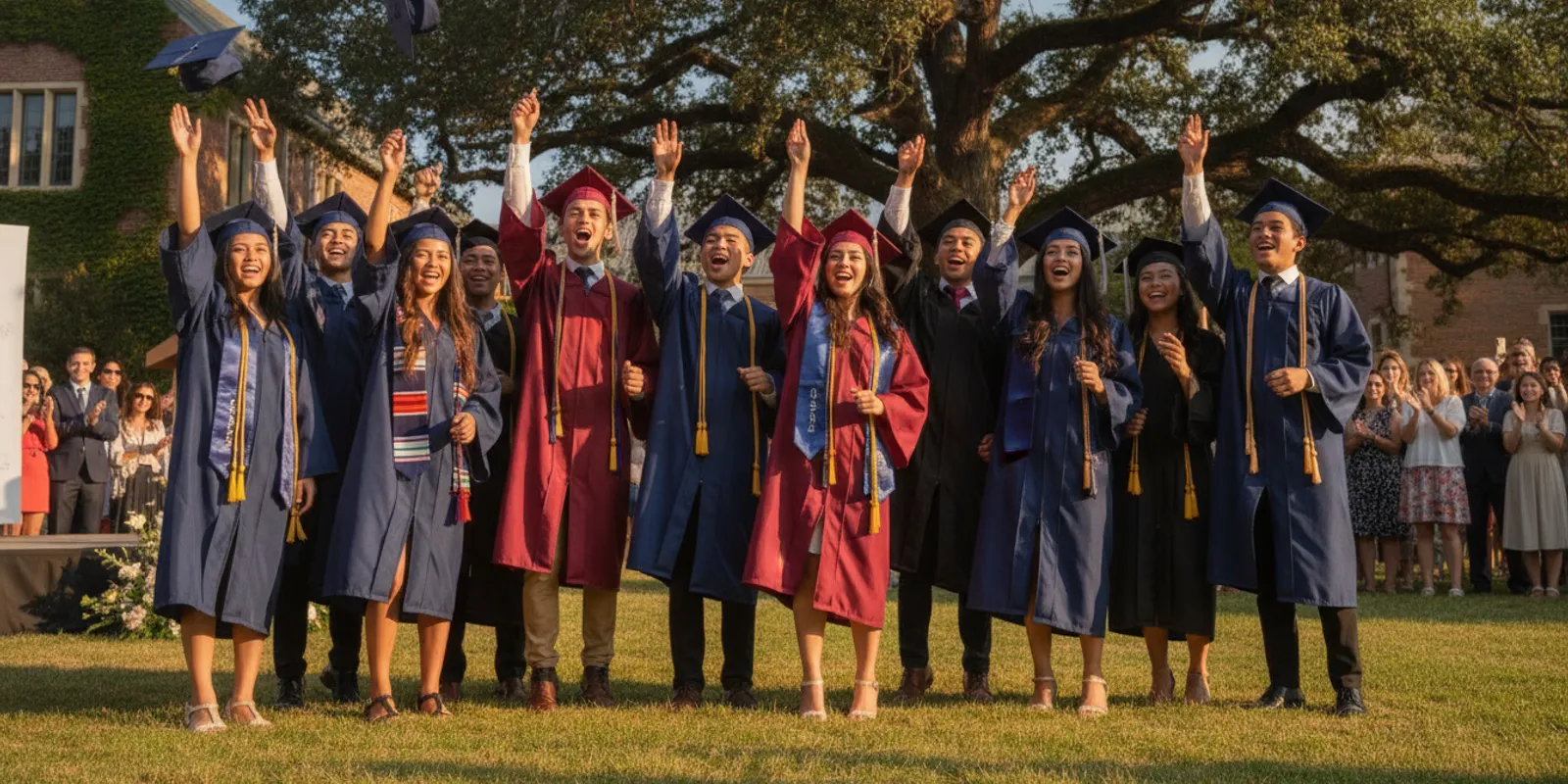

Do online students graduate in person? Sometimes they do, but attending a ceremony and earning a diploma are separate questions. An online student may complete the school’s academic requirements without attending a physical commencement. Whether a ceremony is offered, required, or practical depends on the school and its policies. Families comparing online high school programs should verify both the academic path and the event details before enrolling.
Ask Ideal School about enrollment options
What does it mean to graduate in person?
Families may use “graduate in person” to mean different things. One student may be asking whether they can walk across a stage, receive a diploma cover, and celebrate with classmates. A parent may instead want to know whether the student must attend a campus to finish coursework, take exams, or qualify for a diploma. These are distinct matters, so ask each question directly.
A commencement ceremony is an event. Graduation is the school’s decision that a student has met its published requirements. Some schools host gatherings that students can attend; some arrange virtual celebrations; and some do not offer a formal event. Even when a ceremony is available, participation may be optional and subject to its own arrangements.
Do not assume that “online” means there can be no in-person celebration. Nor should a family assume that a school offers a local event just because it awards diplomas. The school’s current written information is the best guide. For a starting point, review the school’s frequently asked questions and contact the school for details that are not addressed there.
Can an online student earn a diploma without attending a ceremony?
In many school settings, ceremony attendance is not what determines whether a student has graduated. The relevant question is whether the student completes the academic and administrative requirements that apply to that school and program. Those requirements can vary. Ask for the current graduation policy rather than relying on a general statement about online education or on another school’s rules.
Request a clear explanation of the requirements that apply to your student’s grade level and intended graduation date. Depending on the school, the discussion may cover required courses, credits, assessments, records, and deadlines. Confirm how the school evaluates completed coursework, how it communicates progress, and what steps take place after the final requirements are met. Ask whether any in-person attendance is required for instruction, assessment, or administrative reasons, and request the answer in writing.
Families should also clarify what the school means by “diploma.” Ask who awards it, what completion record the student receives, and whether the student’s plan meets the family’s next-step needs. If the student may apply to colleges, training programs, or another school, identify those plans early. Contact the receiving institution or relevant authority directly to confirm its requirements; an online school’s description cannot guarantee how another institution will evaluate a student’s record.
For school-specific information, look over Ideal School’s accreditation information and ask how the program’s policies apply to your situation. Accreditation is one useful item to verify, but it does not replace a careful review of course requirements, records, or an individual student’s plans.
If a student is already in high school, ask how the school reviews work completed elsewhere before estimating a graduation date. Gather transcripts and course descriptions if available, then ask which records the school needs and how it makes placement decisions. Do not count a course toward completion until the school has confirmed how it will be treated in the student’s plan.
For a student close to graduation, ask for a written progress check that shows what is complete, what remains, and the next dates the family needs to track. Verify who reviews the student’s final records and how the family will learn that all requirements have been met. Early clarification can help prevent a ceremony question from obscuring an academic requirement that needs attention.
It can help to turn that progress check into a simple timeline. List each remaining course or assessment, the person responsible for confirming it, and the date by which the school expects completion. Add administrative milestones, such as transcript review, final record processing, and any deadline for registering for an event. If a requirement is unclear, write down the exact question and ask the school to identify the policy or document that answers it. This makes it easier to distinguish a task the student still needs to complete from a step the school handles after completion.
Families can also create a folder for the documents that support the plan. Keep copies of prior transcripts, the current course plan, written policy answers, progress updates, and messages about the ceremony in one place. Label files with dates so it is clear which answer is current if a policy or plan changes. Before making travel arrangements, confirm that the academic completion date and ceremony date are separate calendar items, and ask the school to explain any relationship between them.
What should families compare before choosing a program?
Compare more than whether a school has a graduation ceremony. A suitable program should make its academic expectations understandable and explain how students get instruction, feedback, and help. Families can use the questions below to organize a conversation with each school under consideration.
| Area to compare | Questions to ask | What to confirm |
|---|---|---|
| Diploma requirements | What courses, credits, assessments, or records are required? | Current written requirements for the student’s program and expected completion date. |
| Instruction format | Are lessons live, self-paced, or a mix? How often does the student meet teachers? | Weekly schedule, participation expectations, and time-zone fit. |
| Academic support | How can a student ask for help, and how is progress shared? | Available contact routes, feedback practices, and the process for discussing concerns. |
| Graduation event | Is a ceremony offered? Is it optional, and where and when would it take place? | Whether an event is planned for the student’s cohort and what participation entails. |
| Records and next steps | What documents are issued, and how can a family request them? | Names of records, delivery process, and any relevant deadlines or fees. |
Use the same questions for every school so the answers are easier to compare. Take notes, save policy links, and follow up on anything that sounds uncertain. A broad promise such as “college prep” or “flexible learning” is not a substitute for details about a specific student’s course plan and records.
When comparing responses, distinguish between a definite policy and a possibility. For example, “we usually hold an event” does not confirm that this year’s graduating group will have one, and “records are available” does not explain how to request them. Ask each school to identify which details are confirmed, which depend on the student’s plan, and when unresolved details will be settled. This gives families a fair comparison even when one school’s event calendar is not yet available.
How should families plan for a graduation event?
Once a school confirms that an event is planned, ask for practical details before making travel or family plans. Confirm the date, location, expected arrival time, registration steps, and whether the student needs to bring or wear anything. Ask when the school expects to share final details and whom to contact if plans change. Do not book around an unconfirmed date or assume a ceremony will happen every year.
Consider who hopes to attend and what is realistic for the household. Some relatives may live far away or have schedule, mobility, or travel limitations. Ask whether the school will provide a virtual way to participate or share a recording, but treat those as questions rather than assumptions. A student can also mark the achievement in a family gathering or another meaningful way, even when a school event is unavailable.
For students completing school from another time zone or location, ask whether the event is tied to a particular campus or region. Clarify whether attendance has any academic consequence; usually the ceremony itself is distinct from coursework, but the school must confirm its own policy. Keep copies of the policy and event communications so the family can revisit details as the date approaches.
How does live online learning shape the school experience?
Online schools do not all operate in the same way. Some rely heavily on independent work; others schedule live classes where students and teachers meet at the same time. A family should consider which format helps its student stay engaged, ask questions, and build a consistent routine. Ask to see a sample schedule or class demonstration and find out what participation looks like day to day.
Ideal School describes its K-12 model as live, synchronous instruction and offers English and Spanish learning. Families can explore the school’s online bilingual K-12 program, learn about its full-day program, or review the separate subject options listed under supplemental classes. Compare the structure and responsibilities for each route rather than treating them as interchangeable.
Live instruction can provide regular contact with teachers and peers, but the schedule must work across the family’s time zone and daily commitments. A 2022 study comparing remote and in-person learning reported that participating students preferred in-person teaching and reported higher engagement, learning, and understanding in classroom teaching. That finding is a reason to ask how a particular online program supports interaction; it is not proof that every student will have the same experience. Read the study on remote and in-person learning.
Ask whether students work together during lessons, how teachers invite participation, and what happens when a student misses a live session. Clarify how families receive updates and who to contact when the schedule or workload becomes difficult. These practical details give a more useful picture than a label such as “virtual” or “flexible.”

What should bilingual families ask about high school?
For a student interested in bilingual learning, ask how each language is used in instruction and how the school assesses progress in both. Find out which courses are taught in each language, what level of language proficiency is expected, and how a student who is new to the model receives support. A program description should make the language plan understandable, not leave families to infer it from a general bilingual label.
Also ask how language learning fits into the student’s graduation plan. Confirm which courses count toward the program’s requirements and how academic records describe completed work. If the student has prior coursework, ask how the school reviews records and whether any placement or assessment steps may be needed. Do not assume credits transfer automatically; request an individual review and check any outside requirements that matter to your family.
Families can learn about Ideal School’s teachers and its student experience as part of that research. Useful questions include how students interact in class, how they receive feedback, and how the school helps them participate in a language they are still developing. Ask for examples connected to the student’s age, language background, and academic goals.
Language goals should be specific enough to revisit over time. Ask what progress looks like in speaking, listening, reading, and writing, and how teachers share observations with students and families. Find out how the program responds if a student needs more support in one language or is ready for additional challenge. A thoughtful conversation can reveal whether the school’s approach matches the student’s current skills without making assumptions based on family language use alone.
It is also useful to ask how the school balances language development with the rest of the academic workload. Clarify how the student will learn required subject content, where to find course expectations, and how families can raise concerns if the pace feels difficult. These questions apply whether the student is already fluent in both languages or is building proficiency in one of them.

How can a family make a confident decision?
Use a short, repeatable review process rather than deciding from a single feature or a promotional phrase. First, write down the student’s priorities: diploma path, language goals, amount of live instruction, schedule, support, and likely next steps after high school. Mark which priorities are essential and which are preferences.
- Ask for current requirements. Request the school’s graduation policy, course expectations, and the process for evaluating prior records.
- Check the weekly routine. Compare class times with the student’s time zone, family schedule, and ability to attend live sessions.
- Ask about support. Find out how students communicate with teachers, how progress is reported, and whom families contact when concerns arise.
- Separate the diploma from the ceremony. Confirm completion requirements independently from whether an event is offered, optional, or accessible to your family.
- Verify the next step. If the student has a specific college, program, or transfer goal, ask that destination what documentation it needs.
After conversations, send a short follow-up message summarizing the answers and asking the school to correct anything you misunderstood. Keep the replies, policy documents, and course plan together in one place. This creates a simple reference for enrollment decisions and later questions about progress or completion. If two staff members give different answers, ask for clarification from the person responsible for the relevant policy instead of choosing the answer that sounds most favorable.
When comparing costs, ask what tuition includes and whether there are additional one-time or optional charges. Request current figures and terms rather than relying on an old page or a third-party summary. Ideal School’s tuition information is a useful place to begin, and families can ask how charges relate to the program they are considering. Also confirm the enrollment process and the records the school needs before a student can begin.
If you are still weighing options, review the school’s overview of its approach and compare it with the student’s own needs. A strong match is one where the family understands the schedule, communication, academic expectations, and likely path to completion before making a commitment.
Explore the next step for enrollment
Frequently asked questions
Can a student receive a diploma without attending a graduation ceremony?
Often, ceremony attendance and academic completion are separate. The student must meet the school’s requirements, while participation in an event depends on that school’s policy. Ask the school to confirm both points in writing.
Do all online high schools hold an in-person commencement?
No single rule applies to every online school. Some may offer an in-person event, others may hold a virtual gathering, and some may not have a ceremony. Ask whether an event is planned for the student’s cohort, where it would take place, and whether attendance is optional.
Can an online student attend a traditional graduation event?
That depends on the school and the event’s eligibility rules. Ask the school whether online students may participate and what arrangements, registration, or travel would be involved. Do not assume an event is available in a particular city or year.
What should families verify about a high school diploma?
Confirm who awards the diploma, the program’s current completion requirements, which records the student receives, and how to request those records. If the student plans to apply elsewhere, verify documentation requirements with the receiving institution as well.
An online education can lead to a meaningful graduation experience when the academic plan, student support, and family expectations are clear. Confirm the details with the school early so your student can focus on learning and look ahead with confidence.

Written by
Eric C. Franzen
Eric C. Franzen is co-founder and owner of Ideal School, with 20+ years of experience as an educational leader and entrepreneur. He holds a BA in Education from the University of Washington and an MA in Educational Administration from Seattle Pacific University.
View LinkedIn Profile →