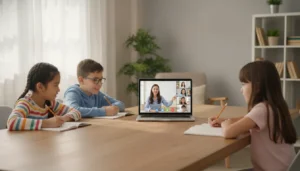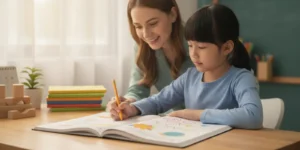


In a crowded virtual classroom, a quiet student can disappear behind a muted microphone. Small groups give teachers the time and space to notice, respond, and invite every student into the lesson.
Small class sizes online school programs make live virtual learning more personal, responsive, and engaging throughout each school day. With fewer students on screen, teachers can notice confusion sooner, adapt instruction, give useful feedback, and invite every child into the discussion. Students gain more chances to ask questions, share ideas, and build relationships without the social pressure that often comes with a crowded class. Oregon State University shared research that found higher final grades in online STEM and upper-division classes with fewer than 30 students. That result shows class size can shape both learning outcomes and the daily classroom experience. At Ideal School, small live classes support real-time collaboration, personalized instruction, and meaningful participation within an accredited, two-way dual-language immersion model for families worldwide.
For parents, the key question is not simply how many names appear on a roster. It is how class size changes what a child experiences during each live lesson. That leads directly to Why small class sizes matter in an online school, so let’s begin.
Small Class Sizes Online School: Why small class sizes matter in an online school
In an online school, a small class is not simply a shorter list of names on a screen. It changes how often teachers can notice, invite, and respond to each student. That attention helps turn a live video lesson into an active classroom rather than a one-way presentation.
Greater teacher visibility
With fewer students present, teachers have more time to watch how each learner responds during a live lesson. They can spot a puzzled expression, a quiet student, or a strong answer that deserves a follow-up question. They are also more likely to notice when a student needs a new example or added practice.
Research from Oregon State University found higher final grades in online STEM and upper-division courses with fewer than 30 students. This finding does not set a universal K-12 limit, but it shows why class size deserves careful thought online. Fewer students can give a teacher more chances to check understanding before the lesson moves ahead.
More meaningful participation and feedback
Participation becomes more useful when each learner has room to speak, ask questions, and work with classmates. In a small live class, discussion does not need to be limited to the fastest students. Teachers can invite varied views and make space for students who need more time to form an answer.
- Students have more chances to explain their thinking aloud.
- Teachers can give feedback while the lesson is still fresh.
- Small groups make peer discussion easier to guide.
- Questions can shape the lesson instead of waiting until later.
These exchanges also help teachers adjust the pace. A quick check may show that the group is ready to move on. It may also show that a key idea needs another example. Families can see how this works in an overview of the benefits of small class sizes during live online instruction.
Stronger classroom relationships
Relationships grow through repeated, focused exchanges. When teachers know each student’s interests, learning habits, and goals, they can make lessons more relevant. Students may also feel more at ease asking for help because they are known members of the class.
Classmates benefit from that same sense of familiarity. Regular discussion and group work help students learn how others think, including peers from different cultures and places. In a dual-language classroom, these close exchanges give students a practical reason to listen, respond, and build language skills together.
For families comparing programs, class size should be viewed alongside teaching format. A small class has the most value when a qualified teacher leads it live, checks progress, and gives clear feedback. That mix makes the student-to-teacher ratio part of the learning design, not just a number.
How smaller classes create personalized attention
More useful teacher feedback
Smaller classes do more than place fewer names on a teacher’s screen. They give the teacher more chances to notice how each student responds during a live lesson. A quiet pause, repeated error, or strong answer can guide the teacher’s next question.
This close view helps feedback become specific and timely. Instead of giving the whole class the same broad note, a teacher can address one student’s reasoning or skill gap. The student can then ask a follow-up question while the lesson is still fresh.
Research on university online courses also shows that class size can shape learning results. One Oregon State University study found higher final grades in smaller online STEM and upper-level courses. K-12 settings differ, but the finding supports careful attention to online class size.
Instruction that fits each learner
Students do not all need the same explanation. One may need a visual example, while another may be ready to apply the idea in a new way. In a smaller live class, the teacher has more room to adjust questions, examples, and practice.
Differentiated instruction does not mean creating a separate lesson for every student. It means changing the level or type of support when the teacher sees a need. That support may include a prompt, extra model, short review, or more complex task.
This approach can help students who learn in different ways take part without being left behind or held back. Families exploring small class sizes in online school can also consider how teachers adapt live instruction to each learner.
Flexible pacing and steady support
A live class still follows a lesson plan, but smaller groups give teachers more choices within that plan. They can pause when several students need another example. They can also move ahead when students show that they understand the skill.
Small groups make it easier to check understanding throughout the lesson, not only after an assignment. Teachers can invite each student to explain an idea, solve a problem, or respond in both languages. These checks reveal where support is needed before confusion grows.
For families comparing a small class sizes online school, the key question is not just how many students attend. Ask how often teachers respond, adapt instruction, and check each student’s progress during live class. Personalized attention is the result of those daily teaching choices.
What does student engagement look like in a small online class?
In a small live online class, engagement is visible and shared. Students speak, respond in chat, solve problems, and work with classmates during the lesson. The teacher can notice who joins in, who needs help, and when the group needs a new approach.
More room for discussion
Smaller groups give each student more room to ask questions and explain ideas. A quiet student has fewer voices to compete with, while an eager student can take part without taking over. This balance turns screen time into an active lesson instead of a one-way presentation.
Teachers can vary the way students participate. One learner may answer aloud, another may post in chat, and another may show work on screen. Because the group is small, these different forms of participation remain visible and useful.
Class size also affects how much attention an instructor can give during online learning. An Oregon State University study of online class size found higher final grades in certain courses with fewer than 30 students. This does not measure engagement by itself, but it shows why teacher capacity matters online.
Purposeful student collaboration
Small groups make partner tasks and group projects easier to guide. Teachers can assign clear roles, visit breakout rooms, and bring students back together to share what they learned. Each student has a real job, so collaboration is less likely to become one person doing all the work.
In a two-way dual-language class, students also learn by listening and responding across languages and cultures. Real-time exchange gives them a reason to use new skills with classmates, not just complete work alone. Our guide to live online teaching explains more benefits of small class sizes during a shared lesson.
Teacher check-ins and social connection
In a small class, a teacher can check understanding without stopping the whole lesson. A quick question, short conference, or review of student work can show where support is needed. The teacher can then adjust the task, group students with care, or offer a new example.
Frequent contact also helps students know one another. They can greet classmates, celebrate progress, and build routines that make attendance feel meaningful. For globally mobile students, a steady class community can offer familiar faces even when their location changes.
Strong engagement does not mean every student speaks at every moment. It means the teacher has several ways to invite participation and can notice patterns over time. That is the practical value of small class sizes in an online school. Students gain more chances to take part, connect, and receive timely guidance.
Small online classes versus large online programs
Class size shapes how often a student speaks, receives feedback, and works with classmates during a live online lesson. Parents seeking small class sizes online school options often want each learner to be visible to the teacher. A large program may offer broad course choices, but enrollment size alone does not describe the daily learning experience.
The learner experience at a glance
Families should compare what happens inside each class, not just the size of the whole school. A large online program may still divide students into small groups. Likewise, a small school may rely on lessons that give students little direct contact with a teacher.
| Learning feature | Small live online class | Large online program |
|---|---|---|
| Teacher contact | Frequent direct conversation | Varies by course design |
| Student participation | Each student has regular chances to speak | Participation may use chats, forums, or groups |
| Feedback | Teacher can respond during the lesson | Feedback may arrive after the lesson |
| Peer connection | Students see familiar classmates often | Classmates may change across courses |
| Pacing | Teacher can adjust to the group | Often follows a set course pace |
Why live interaction matters
In a small live class, the teacher can notice confusion, ask a follow-up question, and adjust the lesson in real time. Students also have space to explain ideas and learn from one another. These exchanges are central to the benefits of small class sizes in a virtual classroom.
Evidence from university courses also points to the role of online class size. An Oregon State University study summary reports higher final grades in some online courses with fewer than 30 students. K-12 families should not treat that number as a universal cutoff. Still, it shows why class design and teacher access matter.
Questions families can ask
A useful comparison goes beyond the published student-to-teacher ratio. Parents can ask how many students attend each live lesson and how often each child speaks. They can also ask who reviews work, how quickly teachers respond, and whether learners meet the same classmates each week.
The answers show whether a program offers personal support in practice. Small classes work best when teachers use that setting for discussion, timely feedback, and active group learning. For students, the key difference is not a label. It is whether they can take part, build relationships, and get help when they need it.
How can families evaluate class size in an online school?
A small class count matters, but the number alone does not show instructional quality. Families should also ask how often each student speaks, receives feedback, and gets help during live lessons. Research from Oregon State University found higher final grades in some online courses with fewer than 30 students.
The right limit may vary by grade, subject, and lesson format. A school should explain why its class limit supports active teaching rather than simply calling its classes small.
Questions about live teaching
Ask to observe a class or view a full sample lesson. Look beyond polished clips and note whether students discuss ideas, solve problems, and respond to the teacher. These details help families see the benefits of small class sizes in a real virtual classroom.
- Ask how many students attend each live class. Request the usual class count and the firm maximum for your child’s grade and subjects.
- Ask how teachers involve every student. Find out whether lessons include discussion, individual questions, group work, or chances to present ideas.
- Ask how quickly a teacher can respond. Learn when students may ask for help and how long feedback on assignments usually takes.
- Ask what happens when a student struggles. Check whether the teacher adjusts instruction, offers added meetings, or coordinates support with the family.
- Ask how the school checks participation. Attendance alone is not enough. The school should track meaningful involvement and follow up when a student becomes quiet.
Teacher access beyond class
Teacher access should be clear and easy to use. Ask whether students can reach teachers through office hours, messages, or planned one-to-one meetings. Also confirm who responds when the main teacher is not available.
Families should learn whether support comes from the classroom teacher or a separate service team. Direct access helps the teacher connect a student’s questions with recent class work and progress.
Evidence of participation and support
Ask the school to show how small classes shape daily instruction. Useful evidence includes sample feedback, progress reports, and clear examples of how teachers adapt a lesson. Families comparing a full-day online school program should also ask how teachers share updates across subjects.
A strong answer describes what students do, not just how many names appear on a roster. When reviewing a small class sizes online school option, focus on visible interaction, timely support, and teacher knowledge of each learner.
How Ideal School makes small classes meaningful
Ideal School treats a small class as a setting for active teaching, not simply a lower headcount. Students and teachers meet in synchronous virtual classrooms, so lessons happen live. The format gives teachers room to listen, respond, and keep each student involved throughout class.
This approach makes small class sizes in an online school useful in daily practice. Teachers can notice how students take part and adjust their support as a lesson unfolds. Students also have more space to ask questions, share ideas, and work with classmates from different cultures.
Live teacher contact
In a live class, teacher attention shapes the learning experience. A low student-to-teacher ratio helps instructors keep discussion focused and invite each learner into the conversation. It also supports real-time feedback instead of leaving students to work through every question alone.
Class size can affect online learning outcomes. Oregon State University research found higher final grades in smaller online STEM and upper-level classes than in classes with 30 or more students. At Ideal School, small groups support the live interaction at the center of each lesson.
Two-way immersion in practice
Ideal School uses a two-way dual-language immersion model in its synchronous classrooms. Students learn through both English and Spanish while taking part in a multicultural class community. Small groups give them frequent chances to speak, listen, and build meaning with teachers and peers.
The model depends on real exchange. Language grows through use, so students need time to answer, explain, and respond to one another. Ideal School’s educational approach brings those exchanges into a structured K-12 program for families in many locations.
A connected full-day experience
Small classes also help connect each part of the school day. Teachers can guide group work, check understanding, and keep students engaged across subjects. Personal attention and peer interaction work together, rather than competing for class time.
The Ideal School Full Day Program places this method within a full academic schedule. Students gain the reach of online education while still learning with teachers and classmates in real time. That blend makes class size meaningful: fewer students create more room for active, shared learning.
What should families expect from a small online class?
A quality small online class offers more than a low enrollment number. Families should expect clear communication, responsive teaching, a welcoming peer group, and a learning model that fits their child.
Clear, steady communication
Communication should be predictable for both parents and students. Families should know how teachers share progress, respond to questions, and raise concerns before a small issue grows.
Regular updates should explain current work, student strengths, and the next skill a learner needs to build. In live lessons, teachers should also check understanding often instead of waiting for a test or report card.
Responsive teaching and active community
Fewer students should give the teacher time to notice confusion, adjust the pace, and offer useful feedback. This does not mean every learner follows a separate curriculum. Teaching can respond when a student needs more practice, a new explanation, or added challenge.
Research from Oregon State University found higher final grades in online STEM and upper-level courses with fewer than 30 students. These results do not set a universal K-12 limit. Still, they show why families should ask how class size supports timely instruction.
A small class should feel social without making students compete for attention. Students need regular chances to speak, listen, work together, and learn from classmates with different backgrounds. In a dual-language setting, active exchange matters because students build language skills through real use with teachers and peers.
Families should expect clear norms for participation, respect, and group work. Teachers should draw quieter students into discussion while making sure confident voices do not dominate. A school’s explanation of how live online classes work can show whether students actively join each lesson.
A good fit for the learner
Families comparing small class sizes online school options should look beyond the enrollment number. They should ask whether classes are live, how teachers track growth, and what happens when a child needs help.
Program structure matters too. A strong fit is visible in a child’s ability to join, contribute, learn, and form steady relationships. No single setting suits every family, so expectations should rest on evidence and the student’s daily experience.
Frequently Asked Questions
What is considered a small class size?
A common benchmark for a small class is about 15 students per teacher. At that size, teachers can better learn each student’s needs, learning style, and personality. The AASA also reports strong evidence for classes near a 1:15 ratio, especially in primary grades. However, the right size can vary by age, subject, and teaching format.
What is the optimal class size for online courses?
There is no single optimal size for every online course. Age, subject difficulty, and the amount of live discussion all matter. Research from Oregon State University Ecampus identifies 30 students as a possible tipping point where some online instructional benefits may decline. K-12 live classes often need fewer students so teachers can monitor understanding and invite regular participation.
How do small class sizes impact student learning in online schools?
Small online classes give teachers more opportunities to notice confusion, provide feedback, and adjust instruction during live lessons. Students also have more chances to ask questions and contribute without competing with a large group. In bilingual or multicultural classrooms, this extra interaction supports language practice and peer collaboration. The benefit comes from purposeful teacher attention, not simply having fewer names on a class list.
Can small class sizes lead to better teacher-student relationships in an online school?
Yes, small class sizes can help online teachers build stronger relationships because they have more time to learn each student’s interests and progress. Frequent live interaction also helps teachers notice changes in participation or confidence. At Ideal School, synchronous classes pair a low student-to-teacher ratio with real-time collaboration. This approach helps make personalized support and meaningful peer interaction part of the regular school day. For students who need additional personalized support, Ideal School also offers online tutoring classes in every core subject.
Ready to Give Your Child More Room to Participate?
Waiting to find the right online school can leave your child in classes where speaking up, asking questions, and building confidence feel harder. Starting now gives your family time to compare options, understand daily routines, and choose a supportive learning setting before the next transition arrives. Ideal School’s small, live classes create more room for real-time teacher interaction, active participation, and meaningful connections within a multicultural learning community.
Ready to explore whether this approach fits your child’s learning needs, goals, and your family’s plans? Learn more about the full-day program and contact Ideal School to ask questions, review the program, and plan your child’s next step.

Written by
Eric C. Franzen
Eric C. Franzen is co-founder and owner of Ideal School, with 20+ years of experience as an educational leader and entrepreneur. He holds a BA in Education from the University of Washington and an MA in Educational Administration from Seattle Pacific University.
View LinkedIn Profile →