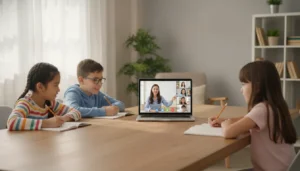




As a parent, you want what’s best for your children. You want them to excel in school and have every opportunity to succeed in life.
Of course, we want the best for our own child.
So when it comes to their education, you want to make sure they’re getting the best possible education – one that will set them up for success both now and in the future and what online learning can do for your child. Online learning can do just that for various reasons:
- They’ll develop important 21st century skills.
- They’ll be able to learn at their own pace.
- They’ll have more flexibility and control over their learning experience.
- They’ll be better prepared for the real world.
- They’ll be exposed to a global community of learners.
- Their educational opportunities will be endless.
So if you’re looking for an education that will benefit your child both now and in the future, consider online learning.
It could be exactly what they need to thrive academically, socially, and professionally.
It’s an exciting time to be a part of online learning and see what this opportunity can do for youth. With so many advantages, it’s no wonder that more and more parents are turning to online learning for their children.
Ready to begin enrollment? So why choose an online school? It really can make a difference in your child. Here we compiled the top six reasons for how online learning for youth can have a significant result.
1. It can help students who struggle in a traditional classroom setting
2. Online learning can be more flexible and accommodating to different schedules
3. Students can learn at their own pace, and go back to review concepts as needed
4. There are often more resources available online than in a traditional classroom
5. Online learning can help prepare students for the workforce by teaching them digital skills
6. It can be more engaging and interactive than traditional methods of instruction
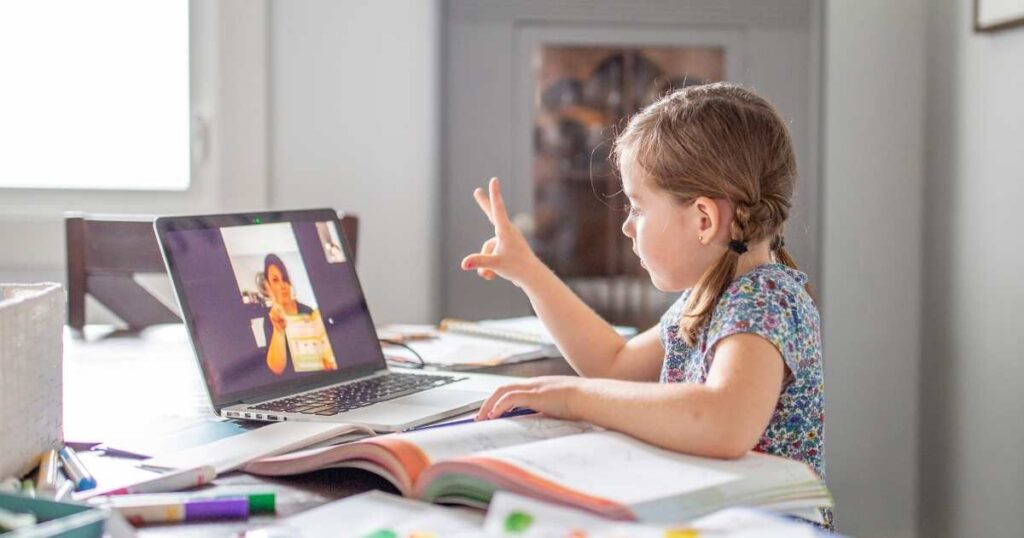
It can help students who struggle in a traditional classroom setting.
Today’s youth are operating in a society where school can be challenging for some students. Traditional classroom settings often don’t work for everyone and it’s important to find different solutions that help youth struggling with school succeed.
Technology can provide an excellent solution to this because it offers students the chance to learn in a way that better suits their needs, as opposed to being restricted by the confines of the traditional classroom setting – and yes, we CAN have a healthy relationship to technology. At Ideal School, we teach with that in mind.
Through technology, youth struggling in school can access resources and support specifically tailored for them, giving them another avenue to get an education.
Online learning can be more flexible and accommodating to different schedules.
With online learning and online classes, the days of needing to adapt your schedule to fit school and class times are gone. You no longer need to plan months in advance for a long-term project or wait until after the winter holidays before continuing a semester-long course.
Thanks to online classes, students, especially youth, can construct their own schedules and arrange their studies around their other commitments.
This makes online learning an incredibly flexible option for those with changing schedules, who don’t have enough time during the day for class or just need more free time on a regular basis. It’s also great for those of us unable to attend greater than one session at a specific time each day due to other commitments like work or travel, who don’t have access to all the same resources as a traditional classroom offers.
With online learning, you can customize your curriculum and make sure it fits into your own personal schedule – something not many people get that luxury anymore!
Students can learn at their own pace, and go back to review concepts as needed.
There are more options than ever to learn and grow at their own pace. Accredited online schools allow students to take as much or as little coursework as they’d like, while still being able to review concepts if needed.
This is ideal for young learners who might not do well with the stricter structure of traditional schooling, where achieving a balance between taking enough courses but not becoming overwhelmed can be difficult.
With an accredited online school, youth have control over their education, deciding when and how much should be done. They can advance on difficult topics or go back for extra help in areas where understanding needs more reinforcement – all at their own pace! Consider pairing that flexibility with bilingual homeschool supplemental classes from Ideal School to provide targeted support and enrichment alongside your child’s core learning.
There are often more resources available online than in a traditional classroom.
Technology has revolutionized the way we learn, and online education is becoming increasingly popular.
With online resources like online lectures, videos, webinars, tutorials, blogs and discussion boards, there are more options than ever when it comes to studying. No matter what you’re interested in learning about – from creative hobbies to mastering difficult technical skills – there’s likely an online outlet for it.
Not only does this mean learners have the flexibility to choose from the myriad of available materials; they have access to significantly more resources if they elect to pursue online education versus a traditional classroom setting.
For example, if you’re looking for an online French course and do not have the opportunity to take one in person at your local college, chances are you can find one online with access to much more detailed information than was available previously.
The online world has opened up so many doors for learning and access to resources! And we’ve embraced it at Ideal School
Online learning can help prepare students for the workforce by teaching them digital skills.
Online learning has a ton of great benefits for students, not the least of which being digital skills. Over digital platforms like Ideal School, students can take courses and certifications that train them in digital literacy, an essential requirement for modern-day job seekers.
Such accredited online schooling provides students the credentials they need to find success in the global workforce while still maintaining educational standards of integrity.
With digital skills becoming increasingly indispensable in almost any workplace, online learning can be a game-changer for those who want to equip themselves with the necessary tools and resources to unlock their potential.
It can be more engaging and interactive than traditional methods of instruction.
Traditional methods of instruction can be laborious and leave learners with little engagement. On the other hand, interactive methods more effectively engage students with the material at hand.
These interactive forms involve activities like role-playing, debates, and computer simulations – all of which allow for much more engagement than just passive listening or writing.
Through these formats, students are able to actively explore subject matter and form their own conclusions about the subject, leading to much greater engagement than traditional teaching techniques.
Interactive learning is a great tool for creating engagement in the classroom and making lessons more memorable.
In Short
If you’re a student who struggles in a traditional classroom setting, online learning could be a great option for you.
Online learning is more flexible and accommodating to different schedules, and students can learn at their own pace. There are often more resources available online than in a traditional classroom, which can help prepare students for the workforce by teaching them digital skills.
Online learning can also be more engaging and interactive than traditional methods of instruction. If you’re interested in exploring online learning options, Ideal School is an accredited online school that offers engaging, interactive courses taught by experienced instructors.
Visit our website to learn more about our program and how we can help you reach your academic goals.

Written by
Eric C. Franzen
Eric C. Franzen is co-founder and owner of Ideal School, with 20+ years of experience as an educational leader and entrepreneur. He holds a BA in Education from the University of Washington and an MA in Educational Administration from Seattle Pacific University.
View LinkedIn Profile →